
GAME DETAIL
Solo King - Single Player : Texas Hold'em Poker and Calculators
種別:ゲーム
発売日:2020年3月4日
日本語対応
1,700円
Steamレビュー
賛否両論
57.9%
57件
SoloKing Poker - A professional poker AI game. Includes a suite of poker GTO calculation tools: win rate calculator, draw calculator, and EV calculator. Professional-level poker AI opponents. It teaches you one thing: 1: How pro players play Texas Hold'em.
このゲームについて
Steamの詳しい説明を読む
This game includes:
Basic Functions:
1: Single-player mode: You can play against 2-9 AI opponents of professional player level.
Core gameplay concept: Range warfare.
1): The core concept of this game is range warfare. When you enable range viewing during the game, you can see your opponents' ranges. As equal competition, the AI will also know your range. Then it's a range-based battle between you and the AI. The AI knows your range, but it won't refine it based on your actions. However, you can manually assess which area your opponent's hole cards are more specifically biased towards within the known range based on the AI's actions.
Similarly, if you don't enable viewing opponents' ranges, as equal competition, the AI won't know your range. It will only calculate its own hand strength, draw chance, nut chance, and whether the current board structure is advantageous to it based on its hole cards and the community cards. The AI also makes its moves based on its own range. Poker Genius created 10 groups for the AI bot, each with different playstyles. I replicated their strategies from Genius. If the range is visible, it calculates the EV based on the hero's range, increasing the chances of winning and making the competition fierce.
In this current war where both sides' ranges are revealed, you're essentially playing a range war with your opponent. The AI doesn't know your hole cards, but it knows your range, and you know your opponent's range. This game is essentially a range war.
It's a war of exploitation based on known ranges.
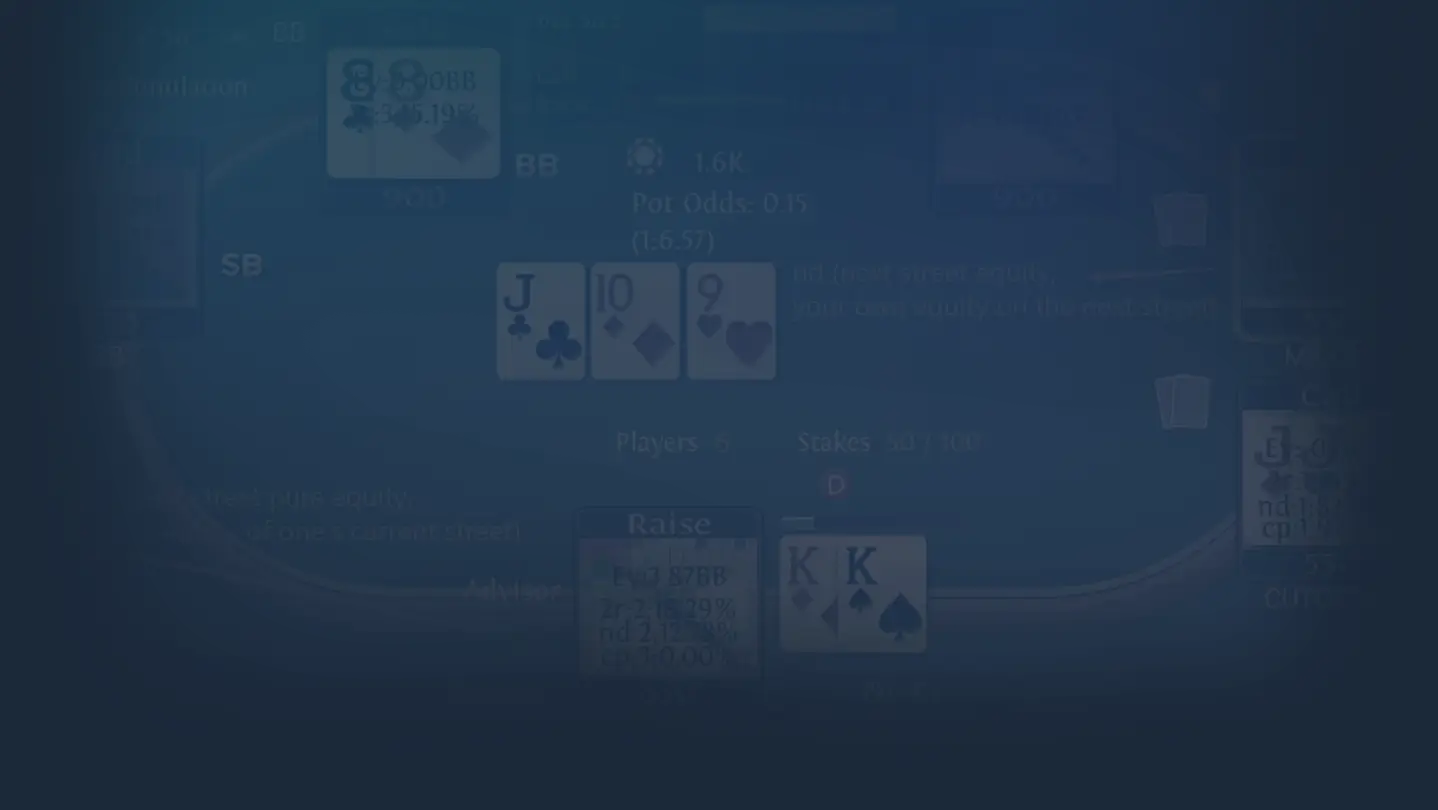
The real-time hand display shows the ranges and draw odds, providing a comprehensive analysis of the range war, the nut war, and the board structure.
Essentially, I've provided a playing environment for training strategic thinking and familiarizing yourself with GTO (Golden Orphanage) playing style.
This game integrates position, stack depth, deep/medium/shallow stack size, bet size, range recognition, real-time win rate, hand strength, and EV based on the current showdown situation.
Because I haven't implemented real-time statistics on opponents' behavior on different streets like in Holdem Manager, I haven't incorporated exploitative techniques based on action habits into the decision-making process (this will be added in the next version, along with statistical items similar to HM3).
Furthermore, the current range isn't trimmed after each action on every street; the action decision EV is calculated based on the initial range of the hand. This means that the AI and hero players can guess each other's ranges, but they don't know exactly where the opponent's hole cards are in that range. However, this is enough to make the game difficult for players; the more players there are, the more tiring and mentally taxing the game becomes.
This game essentially simulates high-stakes online poker games. Players use solvers or assistants to determine their ranges in real-time. GTO (Game Tottenham) is essentially based on the ranges after pre-flop actions between players, then trims the ranges based on those actions, and finds a Nash equilibrium point based on the transparency of each player's range. All EV (Effective Value) calculations in GTO are simulated and not perfectly accurate, but this EV simulates the general decision-making trend.
I've simplified this range estimation process.
Simplifying the range reduction process doesn't diminish the trend logic of actions during the game.
If the trend is correct, then the final comparison is still based on the players' and opponents' assessments of the game's progress and their respective strengths in the current game. The data provided is a calculation, and its results are responsible for the decisions made on the current street, not for the overall game outcome.
The result is simply the cumulative result of decisions made on each street.
(In the next version, I will switch to a pure strategy mode for finding the Nash equilibrium point in the GTO solver to simulate range pruning. Actually, that would be more difficult for players because current solvers are all hybrid strategy modes, which require more card-playing skills to prune decisions.)
2): The exploitative playstyle of human players on the four streets should be as follows, as this is the strategy of AI players in this game:
Preflop Street:
On the preflop street, you practice your ability to judge which street the hand will progress to based on SPR (Sweep Rate). This teaches you how to control the pot size based on your hand strength, showcasing your judgment of the overall hand trend and your betting sizing strategy.
Whether to steal the pot or blinds, control the pot and look at the next street, or push for a showdown on this street.
The charm of poker lies in the strategic planning and bold stealing on the preflop street and the timely probing of opponents' ranges on the flop.
1: Hand strength must match action:
Preflop, if you have a made hand, you can steal the pot or blinds. If your hand is weak, fold; don't limp or call blindly.
The essence of winning or losing is controlling your VPIP. Don't call blindly if you don't have a strong hand; blind calling is the root of losing money.
The difference in SPR (Street Ratio) determines roughly how far the showdown will go.
A low SPR means the game will end on the preflop street, requiring a push/fold strategy to force opponents to fold and maximize fold equity.
Don't try to call to the flop to see the board and increase your chances; that's the wrong approach.
2: In my games, during short-stack phases (stack < 30BB), AI habitually uses a push/fold strategy. Players complain that going all-in is unreasonable, but essentially, they don't understand stealing; they're novices.
If I'm short-stacked, in position, but with a weak hand, I'll definitely go all-in, hoping to steal the pot. If I'm out of position, have a weak hand, but a small stack (it's not like MTT where you just need to survive to the money), in a cash game, I'll go all-in.
When you go all-in, you're betting on your opponent to fold, not trying to get them to call. Even if they do call, it's still a game of luck, not skill. This negates the skill advantage between you and your opponent, forcing you to rely on chance.
At this point, you might try to play slowly, relying on skill, waiting for a good hand to play, thinking this guarantees victory. But that's impossible. Before you get a good hand, simply placing blinds will wear you down. Even if you get a good hand, deep-stacked players have the financial advantage to push and force you out.
Therefore, the push/fold strategy aims to avoid relying on skill and instead rely on luck when your stack is disadvantageous. This drives away tight players, while skilled players won't compete with you for small pots. Skilled players with bankroll control can then play slowly, executing a slow-play strategy.
3. Hand strength must match bet size; a good balance is essential:
If your SPR (Sweep Rate) is high and the preflop doesn't end well, and your hand is strong, you need to control the pot size preflop. Don't grow the pot; wait until the flop to see if the board can continue to expand. After building a large pot preflop, you need to maintain a consistent pot odds on the flop, which requires extremely large bets and makes you vulnerable to pot-ending, affecting your survival time in the hand.
Hand strength determines bet size; you get what you pay for. Betting large with a weak hand is suicidal. At most, make small bets to bluff and see if your opponent has a made hand, as a way to block them. If your opponent raises, you must fold; don't try to win by bluffing.
Flop Street:
This marks the official entry into the range war, the nut war, and the board structure analysis level. This is the most crucial element of flop street decision-making: fold, or keep? If keeping, do I drive out the weak, keep the strong (whether it's setting a trap or bluffing determines the bet size), or play it safe and hope for the next street?
4: On the flop street, the essence of playing is whether you can make the nuts and whether your nut ranking is advantageous. If you don't make the nuts but have a nut draw, you can make a small bluff.
If you can't make the nuts, or don't have a nut draw, and can't check, then fold.
Postflop: With more than two players, the more players there are, the weaker your hand becomes. Fold decisively. For example, on a postflop street with more than three players, if your set isn't strong, you can only call; don't think about raising.
Flop Street: With a short stack, if you have a set or two pair, showdown. Play for fold equity. Don't think about what the turn street is like, don't assume your opponents are calling stations, and don't fantasize. All actions should be based on your hand strength.
Turn Street:
Reaching the turn street is a crucial decision point: value or bluff. Regardless of the decision, betting involves extreme sizing.
Having built pots and roughly assessed your opponents' range on the preflop and flop streets, this street becomes the decisive battleground.
If you're playing value, assess your hand strength, the amount of value you want to capture, the betting size required to achieve it, and whether you should proceed to the river street. On the river street, is your hand strong enough to capture value? If not, end the battle on the turn street.
On the turn street, whether playing value or bluffing, you must build a very large pot and bluff with large bets to force your opponents to fold. Small bets will not achieve your goal, resulting in losses, exposed hand strength, and increased profits for your opponents.
Playing value also requires large bets to build a large pot, maximizing profits when the game ends on the river street.
If you find your hand weak on the turn street, check if you can, fold if you can't check, and avoid hesitation and wishful thinking.
River Street:
On the river street, the hand strength is determined, and whether you've hit your draw is clear. The strategy for the river street is a variation of the turn street strategy, but the bet size needs to be reduced.
Because the hand strength is already determined, a smaller bet size means you're playing value, your opponent will likely call, you maximize your winnings, and even if you continue bluffing, it will be a small bluff, minimizing your losses.
If your bet size is too large, your opponent might fold, and you won't be able to capitalize on the river street's profits with your high-value hand. Even if you're bluffing, if the size is too large, your opponent will likely call, leading to a significant loss. Therefore, the bet size on the river street needs to be reduced to ensure you consistently hit value or minimize losses if your bluff is caught.
These are the basic strategies employed by the AI across the four streets in this poker game.
Regarding the consistency of value and bluff bet sizes:
Hero players should maintain consistency to avoid detection by AI opponents. However, maintaining consistency in bluffing is difficult, serving as a warning against bluffing without a strong hand.
Inconsistent bet sizes make it easy for opponents to discern the correlation between your bet size and hand strength.
In this game, the AI makes betting decisions based on the value-bluff ratio on the turn and river, but inconsistent bet sizes are deliberate vulnerabilities.
To compete for large pots, your hand strength must match.
Understand that most poker profits come either from consistently stealing blinds or small pots preflop to accumulate wealth, or from winning large pots on the turn and river in crucial hands. To compete for large pots, you need at least a straight or flush; don't expect to get rich overnight with a set—hand strength doesn't allow for such fantasies.
Don't think you can win by bluffing. Even if you want to bluff, don't bluff with nothing. At least have a nut draw and bet small
スクリーンショット

評価・レビュー
全体レビュー 賛否両論 好評率 57.89% / 57件 取得:2026年7月21日 22:55
プレイ時間の目安 約2.7時間 Steamの好評レビュー33件から推定 信頼度:標準
ATTENTION
注目度メトリクス
プレイヤー推移
データ蓄積中 24時間平均選択した期間に観測データはありません。
Steamフォロワー推移
2件以上で集計 直近7日選択した期間に観測データはありません。
プレイヤー数とフォロワー数は意味と単位が異なるため、 別々の時系列として表示しています。補間した値は使用していません。
発売後注目度の基礎指標 発売済みタイトルのため、現在プレイヤー数・ピーク値・Steamフォロワー数を組み合わせて勢いを観測します。
| 指標 | 現在値 | 観測状況 |
|---|---|---|
| 現在プレイヤー数 | 0人 | 最終観測:2026年7月31日 20:46(57日経過) |
| 24時間ピーク | データ蓄積中 | 履歴あり・更新待ち・直近7日 0件 |
| Steamフォロワー数 | 未集計 | 最終観測:未集計 |
| 7日フォロワー増加 | 2件以上で集計 | 未集計・直近7日 0件 |
PlayMEXが保存した観測値です。取得時刻と観測数を あわせて確認できます。
ジャンル・機能
ジャンル
機能カテゴリ
ファミリーシェアリング
ゲームライフログ
所有ゲームとして同期されると、 このゲームの記録を残せます。