
GAME DETAIL
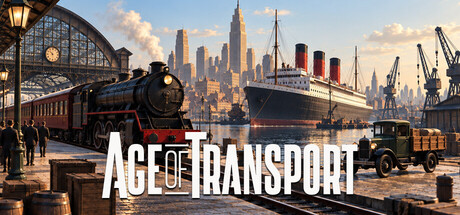
Age of Transport - Blue Marble
種別:ゲーム
発売日:2027年
日本語対応
価格未定
Classification yards, waybills and live dispatch — on a 1:4-scale Earth. Build a multi-modal freight empire across rail, sea and air through twelve eras of transport history, in a persistent world shared by up to 255 companies.
このゲームについて
Steamの詳しい説明を読む
Age of Transport™ - Blue Marble began as a love letter to railroad history. That part never changed.
Trains are dispatched, not assigned to routes. Consists arrive on the receiving tracks, go over the hump, and are sorted through the bowl into new trains. Track is rail, sleepers, fastenings and ballast, and your line is only as good as the worst of the four. Branch lines are built like branch lines, not like mains. Every locomotive in this game was built by someone, somewhere, for a reason — and it still has the reason in it.
What we wanted was for all of that to *matter*.
In every tycoon game ever made, the railroad is how you earn money, which means the operation itself is decoration. Replace the yard with a number and nothing changes but the animation. So we took the money out. Now the railroad isn't how you earn — it's how a world works. A badly planned junction doesn't cost you cash. It means the city on the other side of it doesn't get what it needs.
The map is the actual Earth at 1:4, with more than 70,000 real cities full of people who need things that are somewhere else. You build the mines and the factories, the power stations and the schools — and then you build the thing that connects them, because nothing moves unless you move it.
You get one world of your own, and one company. It's a game meant to be played once, and to still have somewhere to go on your five hundredth hour.
THE SHORT VERSION
The whole Earth, at 1:4 scale. 35 million km², more than 70,000 real cities, real mountain passes and rivers. All installed with the game — no streaming, no network required.
There is no money. Cost is work. You don't buy a locomotive, you build it — from ore you hauled, in a shop that's busy until Thursday.
Real railroading. Trains are dispatched, not assigned to routes. Yards hump and sort. Track is rail, sleepers, fastenings and ballast, and your line is only as good as the worst of the four.
Charters give a planet a purpose. Undertakings, trials, surveys, routes and developments — you choose what kind of game you're playing this month, and the largest of them are the gates between eras.
You build the industry as well. Mines, factories, production chains nine steps deep, and the power stations and grid that keep them running. The chains go deep — but this is not a game about units per minute, it is a game about whether Chicago gets fed.
Your network feeds itself. Your railway hauls coal, and your railway burns coal. Steam wants water towers, electrics want catenary, ships want bunkers, aircraft want fuel on the apron.
Cities are people, not points. They need food, then comfort, then medicine. You zone them and build their schools — and an educated city is the only place your high-tech factories can go.
More than 2,500 rail vehicles, before the ships and the aircraft. The tech tree unlocks capabilities rather than catalogue entries: research the gas turbine and you get every turbine locomotive, not one.
Every mode has real physical limits. Nothing but a ship crosses an ocean. Only a seaplane reaches a place with no runway. Until the late 1930s, no aircraft can fly over a mountain range at all.
Nothing is ever waiting for your attention. A yard rebuild in Chicago, an ore corridor in Western Australia, a river service you have been meaning to fix since last week — all of it running at once, all of it yours to move between. You move between projects, not through time.
Get down to track level whenever you like. Set the spotter panel to what you actually love — steam or diesel, yards, harbours, arrivals, panoramas — and the camera goes and finds it. A coal drag lifting a grade in the Rockies. A night departure under station lights. Your world becomes an aquarium.
Twelve eras, the 1830s to today. You inherit every decision you ever made. The route that was a triumph in 1880 is the bottleneck of 1950.
One world of your own, and only one. Persistent, cloud-synced, never wiped, no restarts — and playable entirely alone for as long as you want.
Or share the planet with hundreds of people. Up to 255 companies in one running world, 500 or more concurrent players on a good dedicated server, and it all keeps running whether you are logged in or not. Persistent multiplayer at this scale is new to the genre.
The other players are your customers. The airline needs concrete for its runways and fuel somebody else refined. The railways need aluminium that crossed an ocean. Past a certain point nobody is self-sufficient, and that is the design working.
Open your world, and let it have an audience. Visitors spectate, found their own company on your map, or join yours as associates. Spectators lock to your camera and see exactly what you see, in real time — and the watchdog tells them the moment you log in, even from a world of their own.
No DLC. No microtransactions. Not ever. Every world is a shared world, so everyone in it runs exactly the same game.
THE WORLD
At a scale of 1:4, planet Earth offers 35 million km² (13.5 million mi²) of familiar and exotic environments alike. Real mountain passes, coastlines and rivers, and more than 70,000 real cities. All part of your basic game installation — no streaming and no network required. Build the Trans-Siberian. Rebuild the Alpine freight corridors. Take on a single country and do it properly, or span a network across every continent.
And the world is real in the way that matters most: things are where they actually are.
Chilean saltpetre is the only route to dynamite until nitrogen fixation arrives in the 1910s, which means South America holds a genuine monopoly on the ability to blast a tunnel through a mountain. Break that monopoly and mountain ranges stop being walls — but until you do, somebody else owns the mountains.
Aluminium needs cryolite, and cryolite means Greenland, which is what makes an Arctic route worth an appalling cost to build. Rare earths mean Asia. Tantalum means Central Africa. Put those together and a computer turns out to depend on three continents at once — you cannot build one from a single landmass, and that isn't a balancing rule. It's just where the ore is.
===== WHAT YOU OPERATE =====
THE RAILROAD
Trains are not assigned to routes. They're dispatched.
You lay down multi-track corridors following a real hierarchy — main lines, secondary lines, branch lines, industrial spurs and yard leads, down to logging lines laid to last a season and no longer. Each class carries its own standards: curve geometry, loading gauge, ruling grade, line speed and the materials available in that era.
The dispatcher plans routes using that hierarchy, so expresses and locals are assigned timeslots on the right tracks. Priorities age, conflicts resolve, meets and passes happen where the infrastructure allows them, and a badly planned junction will teach you exactly why real railroads obsess over junctions. Even a switchback — a zig-zag climbing a mountain in stages — is something the dispatcher will work out for you.
And the track itself is built, not chosen from a menu. Four slots: rail, sleepers, fastenings and ballast. Your line is only as good as its worst one, so the game names the problem — your sleepers are the limit — rather than letting good rail hide a bad foundation. Strap rail on timber baulks does twenty. Head-hardened welded rail on slab track does three hundred and twenty. Getting from one to the other is eleven separate decisions across a century, and the constraint moves every time you solve it.
Build cheap now and upgrade later is a legitimate strategy, not a punished one: half of what you rip up comes back as scrap. Your pioneer iron rails literally become the steel rails that replace them. And the line you laid in 1835 is still there a century and a half later, still doing forty-five, now a rural branch. It never became a liability. It just got old.
THE YARDS
But the real magic happens in the yards.
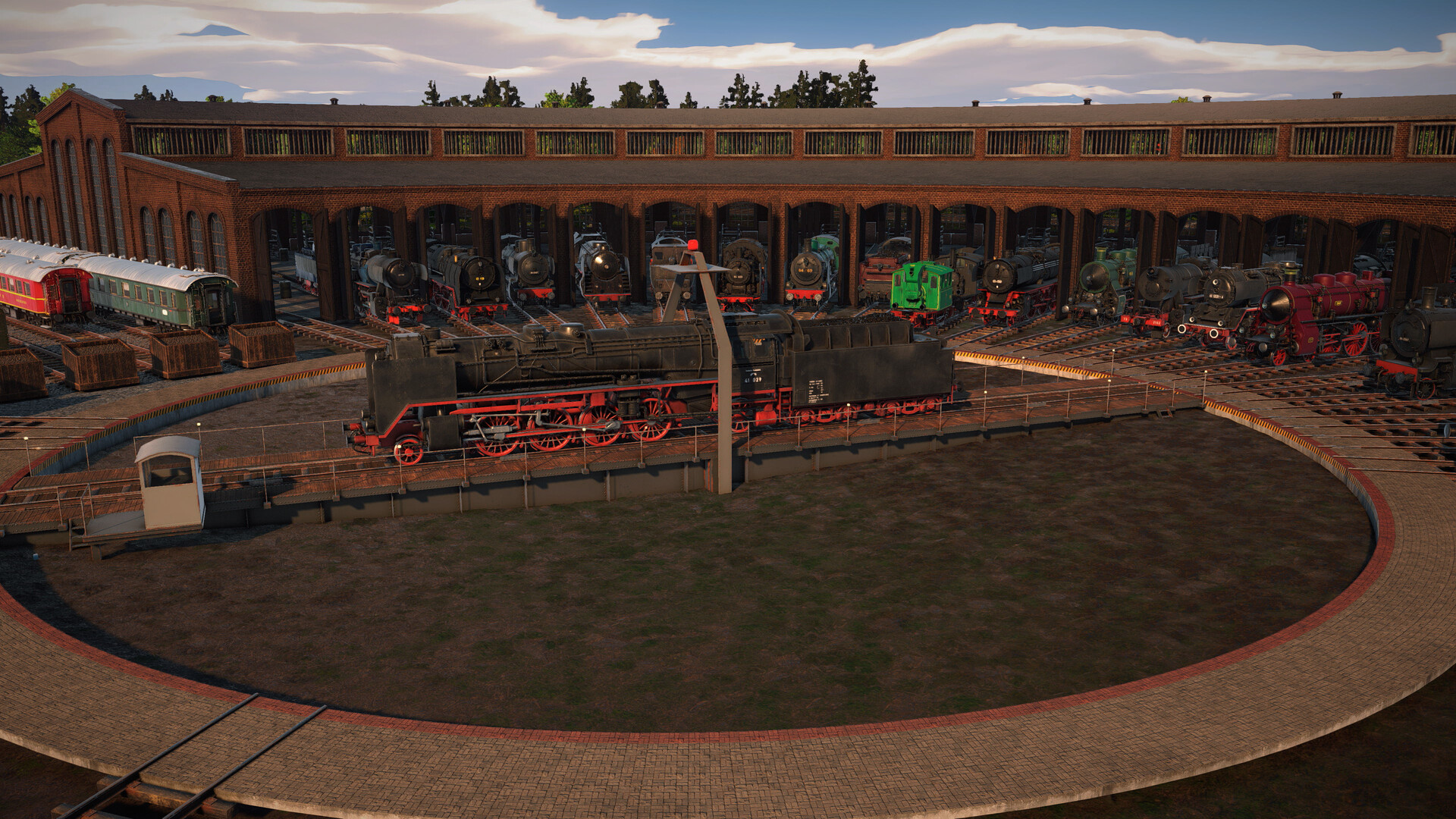
Consists arrive on the receiving tracks, go over the hump, and are sorted through the bowl into new consists on the departure tracks — ready to be picked up for fresh destinations by locomotives waiting at the engine terminal. Get the yard right and the whole network breathes. Yards are the backbone of any railroad.
The rolling stock you build is assigned to yards and given roles: switcher, road switcher, pusher, express, passenger, mixed, local freight or road hauler. From there the yardmaster takes over, using the stock you've provided to build dynamic consists that behave like the real thing.
THE SHIPS
Nothing in this world moves at scale without ships, and nothing else crosses an ocean. Not one locomotive you will ever build, not one aircraft until very late. If a continent has what you need, something has to float it home.
Steam river boats arrive in 1860, and they stay cheap forever — on the corridors a river happens to serve, nothing beats push-tow economics per tonne-kilometre. The Mississippi and the waterways feeding it run thousands of miles into country you have no other way to reach. For a generation, they are your highway.
Coastal ships arrive in 1880 and open both American seaboards, the Gulf and the Caribbean — twenty years before anything can face open ocean.
Ocean vessels arrive in 1900, and from that moment the whole planet is in play. Every scarce thing on the far side of a sea becomes reachable, and every long haul you have ever wanted to run becomes possible.
And ships have their own propulsion story, which is not the one the railways tell. Compound and then triple-expansion engines wring more and more work out of every ton of coal — and at sea that efficiency is the capability, because a ship that burns less carries more and goes further between fuelling stops. Every improvement to the engine lengthens the route you can actually run.
Then the steam turbine arrives and changes the scale of the thing entirely: the great liners, real speed across open water, power no reciprocating engine could match. Steam rules the sea for half a century after it stops ruling the land — and it is heavy oil, after 1950, that finally ends the age of coal at sea.
Icebreakers and ice-strengthened hulls open the Arctic. Much later, LNG carriers and container ships reshape freight entirely.
THE AIRCRAFT
We recreate civilian aviation history, and we take it as seriously as the railways — with particular love for everything before the jets took over.
Between 1920 and 1945 there were almost no runways anywhere on Earth, so water was the airport. That single fact is the reason the seaplane family is at the centre of our aviation rather than off to one side. A water-capable aircraft needs no infrastructure at all — no concrete, no strip, nothing you have to build first. It reaches a region before you can build anything there, which makes it the aviation equivalent of the riverboat.
Bush floatplanes working remote lakes and river bends. Seaplanes on coastal and lake runs. Amphibians that will use water or a strip and cost more than either specialist, and are worth it while the map is still opening. Flying boats carrying real cargo over water twenty years before runways exist. Survey flying boats revealing coastline and interior water you haven't reached. And the transoceanic clippers crossing the Pacific in stages, briefly the most glamorous objects on Earth.
Flying boats, floatplanes, amphibians, clippers and early airliners make up the largest part of the pre-jet roster — this is the part of aviation history we most wanted to get right.
Around them, the rest of the century: pioneer biplanes and mail planes, the first all-metal airliners, tri-motors, crop dusters that consume fertiliser over farmland and raise the yield beneath them, and racing floatplanes that carry no cargo at all and exist purely to advance engine technology, exactly as the Schneider Trophy machines did. Then the DC-3, pressurised airliners, long-range freighters, turboprops, the first jets, widebodies and supersonic.
And every aircraf
スクリーンショット
ATTENTION
注目度メトリクス
プレイヤー推移
データ蓄積中 24時間平均選択した期間に観測データはありません。
Steamフォロワー推移
2件以上で集計 直近7日選択した期間に観測データはありません。
プレイヤー数とフォロワー数は意味と単位が異なるため、 別々の時系列として表示しています。補間した値は使用していません。
発売前注目度の基礎指標 発売前タイトルのため、Steamフォロワー数と7日増加を中心に注目度を観測します。
| 指標 | 現在値 | 観測状況 |
|---|---|---|
| 現在プレイヤー数 | 未集計 | 最終観測:未集計 |
| 24時間ピーク | データ蓄積中 | 未集計・直近7日 0件 |
| Steamフォロワー数 | 未集計 | 最終観測:未集計 |
| 7日フォロワー増加 | 2件以上で集計 | 未集計・直近7日 0件 |
PlayMEXが保存した観測値です。取得時刻と観測数を あわせて確認できます。
ジャンル・機能
機能カテゴリ
#category_playable_at_your_own_paceLAN PvPLAN協力プレイPvPいつでもセーブ可能オンラインPvPカスタム音量調整カメラの快適性シングルプレイヤーテキストサイズの調整ファミリーシェアリング協力プレイ
ゲームライフログ
所有ゲームとして同期されると、 このゲームの記録を残せます。