


GAME DETAIL
HELLO HACKER - Project Daybreak
種別:ゲーム
発売日:2026年第4四半期
日本語対応未確認
価格未定
A story-rich hacking sim played inside a real Linux desktop. Recon networks, break web apps, crack crypto, and extract hidden data with tools that behave like the real thing, while an autonomous AI watches the network, learns, and hacks back. The commands are real. So are the consequences.
このゲームについて
Steamの詳しい説明を読む
Six months ago, you exposed PROJECT NIGHTFALL — an illegal government surveillance program responsible for 23 deaths. The story was buried. The architects walked free.
Now someone is trying to reach you. And they're using a dead woman's photograph to do it.HELLO HACKER 2: PROJECT DAYBREAK
A story-rich hacking simulation played entirely from within a fully realized Linux desktop. Every tool, every application, every terminal window is yours to use. The conspiracy is real. The commands are real. The consequences are real.▶ PLAY THE FREE DEMO
The free demo is the game's complete Prologue — a self-contained mission arc, start to finish, that drops you into a hacker collective called Daybreak and turns you loose on your first real target: Meridian Systems' contractor portal. In a single sitting, you'll:
Decrypt a dead drop and trace a one-word breadcrumb: DAYBREAK
Map Meridian's network with nmap — using stealth scans to slip under their intrusion detection
OSINT the portal's administrator straight off the company's public careers page
Bypass a live login with a real SQL injection, then walk records that were never yours with an IDOR to recover credentials
SSH in, comb the logs and bash history, and pull a hidden payload out of a "corrupted" image
Escalate to root and crack an encrypted secret
Stay quiet — because AURORA is already watching. Let your exposure climb and it will tear down your session, tamper with your notes, and start talking directly to you
It ends on a cliffhanger you'll only reach by going all the way in. No minigames. No hand-holding. Just you, a terminal, and a target.
Tools in the demo: Terminal · Network Scanner · In-Game Browser · Email · Journal · File Explorer
Everything below describes the full game (in development). The free demo covers the Prologue — see above for exactly what's included.THE STORY
A single encrypted dead-drop leads you to a name: Dr. Maren Solís — a senior intelligence analyst who was supposed to be dead. Buried in the image's metadata is one word: DAYBREAK.
Following the trail pulls you into something far larger than Nightfall ever was. A private AI firm called Meridian Systems has been quietly building an autonomous threat-assessment system called AURORA — trained on the surveillance data Nightfall spent years collecting. AURORA doesn't just watch. It decides. And it has already acted, without human review, eleven times.
You join a loose collective of hackers, journalists, and defectors who call themselves Daybreak. Their goal: expose AURORA before its twelfth decision is made.
But AURORA is watching the network. And it learns.A FULL HACKING DESKTOP — NOT JUST A TERMINAL
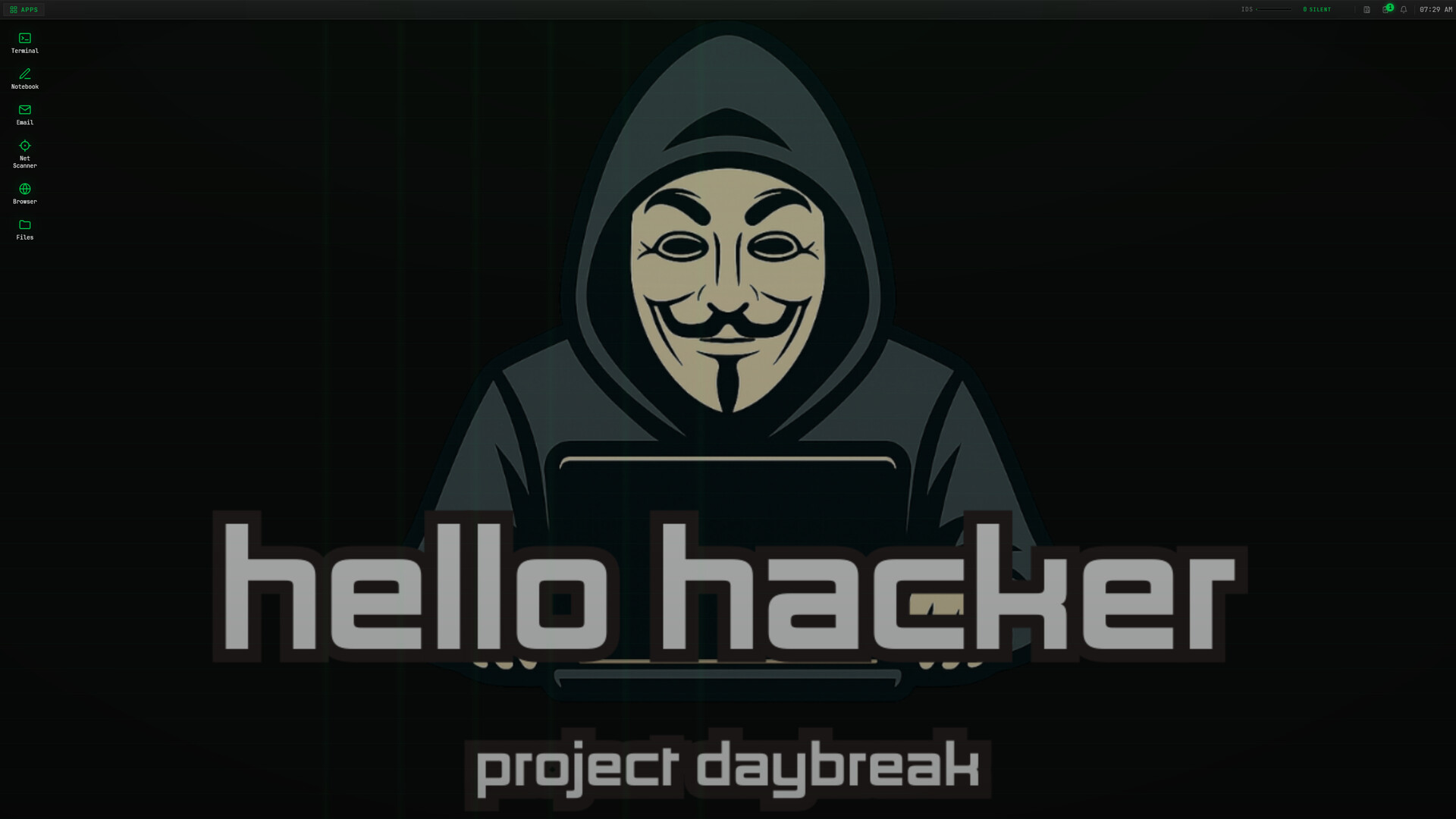
Project Daybreak runs inside a simulated Linux desktop environment. Open multiple applications at once, pivot between tools, and work the way a real analyst would.
Terminal Emulator — A full Unix command set with pipe support, redirection, SSH session stacking, command history, and tab completion. Navigate multi-host networks, read logs, enumerate services, and cover your tracks.
Network Scanner — Map target subnets with stealth, standard, or aggressive scans. Every mode generates a different noise signature on the target's intrusion detection system. A live topology map charts your discovered network in real time.
Browser with Request Interceptor — Access internal web applications. Pause, edit, and replay HTTP requests to find and exploit vulnerabilities — SQL injection, IDOR, SSRF, and more.
Crypto Workbench — Decode ciphertexts, run frequency analysis, crack hashes, derive keys, and operate GPG-style encryption. A built-in frequency chart helps you identify substitution ciphers visually.
File Analyzer & Steg Tool — Inspect files at the byte level. Extract hidden data from images using LSB steganography, find files embedded after EOF markers, and read EXIF metadata that was never meant to be found.
Forensics Workstation — Browse disk images and recover deleted files. Parse network captures and pull credentials from plaintext protocols. Correlate events across multiple log sources into a unified timeline.
OSINT Console — Search simulated social media, WHOIS records, certificate transparency logs, code repositories, corporate registries, and news archives. Build intelligence dossiers and visualize connections on a live link-analysis graph.
Comm Suite — Craft spear-phishing emails, run social engineering campaigns, and navigate vishing scenarios through a branching dialogue system.
Disassembler — Analyze binaries in a readable in-game intermediate representation. Annotate functions, trace cross-references, and patch instructions to bypass license checks and unlock restricted access.
Exploit Console — Match discovered service versions to a library of exploits. Configure payloads, open remote shells, and manage active sessions.
Malware Sandbox — Detonate captured samples in isolation. Watch behavior events fire in real time — file writes, network connections, registry changes — and write detection rules from what you observe.
Password Manager & Cracker — Store discovered credentials, identify hash types, and run dictionary, mask, and rainbow-table attacks. Weak passwords fall fast. Strong ones take time.
OPSEC Dashboard — Monitor your operational security across every host you've touched. Manage your proxy chain, track the forensic artifacts you've left behind, and watch AURORA's global threat level climb.
Script Editor — Automate with a bash-like scripting environment. Schedule scans, chain commands, and build your own tools from the same commands the terminal uses.
OPSEC: THE MECHANIC NO OTHER HACKING GAME HAS
Every action you take leaves a trace.
Every SSH login, every file you read, every failed password attempt generates noise on the target host's intrusion detection system. Push a host's alert level too high and Meridian's security team gets involved. Push it further and AURORA begins to respond directly — rotating credentials, deploying honeypots, hunting the source of the intrusion.
The OPSEC Dashboard tracks your threat posture in real time. Shred log entries. Clear your bash history. Route traffic through a proxy chain. Operate within credential-rotation windows. Work fast enough that nobody notices you were ever there.
Ignore OPSEC and the mission gets harder. Ignore it long enough, and AURORA locks you out entirely.REALISTIC CHALLENGES ACROSS 12 CATEGORIES
Every challenge in Project Daybreak is grounded in real cybersecurity concepts taught in CTF competitions and professional penetration testing:
Network reconnaissance and service fingerprinting
Web application exploitation — SQL injection, IDOR, SSRF, XSS
Cryptographic analysis — XOR, RSA weak keys, padding oracles, hash cracking
Steganography — LSB extraction, whitespace encoding, EOF file hiding, EXIF metadata
Digital forensics — deleted file recovery, PCAP analysis, log timeline reconstruction
Open Source Intelligence (OSINT) — the deepest OSINT mechanic in any hacking game
Social engineering — phishing, pretexting, vishing
Reverse engineering — binary analysis, backdoor identification, patch mode
Privilege escalation — SUID abuse, cron job exploitation, misconfigured sudo
Operational security — artifact cleanup, proxy chaining, IDS evasion
Exploitation — service fingerprinting, CVE-analog matching, payload configuration
Malware analysis — behavioral sandbox, IOC extraction, detection-rule writing
YOUR CHOICES SHAPE THE OUTCOME
The evidence you collect determines which ending is available to you. How you handle OPSEC determines how hard Meridian pushes back. Characters you help — or fail — carry those choices forward.
Three endings. One conspiracy. The truth is in the data.BUILT FOR CYBERSECURITY LEARNERS AND ENTHUSIASTS
Project Daybreak is designed to be genuinely challenging for people who know security — and genuinely educational for people who are learning it. Every technique maps to a real-world concept. Every tool works the way its real-world equivalent works.
Whether you're preparing for CTF competitions, exploring a career in security, or you just want a hacking game that doesn't insult your intelligence — this is it.KEY FEATURES
A fully realized Linux desktop environment with 15 interactive applications
Story-rich single-player narrative across three acts with three branching endings
OPSEC system — every action has a noise signature; AURORA responds dynamically
12 challenge categories grounded in real CTF and penetration-testing disciplines
The most in-depth OSINT mechanic in any hacking simulation game
Multi-host network simulation with SSH pivoting and lateral movement
52 Steam Achievements for completionists and challenge hunters
Built with Rust for a native, performant experience on Windows and Linux
Project Daybreak is a standalone sequel — you don't need to have played Hello Hacker to dive in, but if you did, you'll recognize the world.
The free demo lands soon. Wishlist and Follow now so Steam tells you the moment it's playable — and so you're first through the door when the full game arrives.
Release: TBA — Late 2026 / Early 2027
スクリーンショット
ATTENTION
注目度メトリクス
プレイヤー推移
データ蓄積中 24時間平均選択した期間に観測データはありません。
Steamフォロワー推移
2件以上で集計 直近7日選択した期間に観測データはありません。
プレイヤー数とフォロワー数は意味と単位が異なるため、 別々の時系列として表示しています。補間した値は使用していません。
発売前注目度の基礎指標 発売前タイトルのため、Steamフォロワー数と7日増加を中心に注目度を観測します。
| 指標 | 現在値 | 観測状況 |
|---|---|---|
| 現在プレイヤー数 | 未集計 | 最終観測:未集計 |
| 24時間ピーク | データ蓄積中 | 未集計・直近7日 0件 |
| Steamフォロワー数 | 40人 | 最終観測:2026年9月6日 17:46(21日経過) |
| 7日フォロワー増加 | 2件以上で集計 | 履歴あり・更新待ち・直近7日 0件 |
PlayMEXが保存した観測値です。取得時刻と観測数を あわせて確認できます。
ジャンル・機能
機能カテゴリ
Steam実績いつでもセーブ可能ファミリーシェアリング時間制限付き入力なしでプレイ可能
ゲームライフログ
所有ゲームとして同期されると、 このゲームの記録を残せます。