
GAME DETAIL
Cultist
種別:ゲーム
発売日:2026年7月23日
日本語対応未確認
無料
Steamレビュー
レビュー不足または未評価
50.0%
4件
Cultist is card game about begining of the religions and the way they grow, interact and even become immortal. Can you outgrow the world that contains yourself and become much bigger?
このゲームについて
Steamの詳しい説明を読む
Cultist is a turn-based card game with an anthropological theme that captures the religions and history of the ancient Mediterranean and Middle Eastern world. Through the game, players can become powerful religions and ideas that endure the trials of time, or become mere traces left in relics.
About Cultist
The cards in the game each represent diverse doctrines and ideas befitting their historical background. They grow and develop based on the participation of new cultists. What begins as a simple Beliefs, or merely a collection of those, expands through play into cults and sects, eventually branching into forms resembling actual classical religions.
The overall flow of the game varies each time according to the cards used and their sequence, but the common theme lies in the interactions, commonalities, and mutual influences among early religions.
Religion and It's cultists
Cultists are the source that provides you with the doctrines that strengthen you, but they also serve as the substance that sustains you as an idea itself. When a Cultist is flipped over and used as doctrine, it can no longer function as a Cultist; and after the first turn, any religion that loses all of its Cultists is defeated. Holding many Cultists is a way to protect yourself from other aggressive religions and ideas, and at the same time an excellent strategy for adding compelling ideas to your religious community.
There are various ways to add Cultists.
1. The basic method
By default, every turn each player has one opportunity to draw cards at the start of their turn. At this point, they choose one of the following:
a. Draw Cards: Look at three cards from your deck and add one to your religion. Discard the remaining two.
b. Trade: Take one card of your choice from among the discarded cards.
2. Additional methods
Some cards allow you to draw additional cards in various situations, such as every turn or when a card is flipped. When the text states "perform an additional Draw Cards," follow action a; when it states "perform an additional Trade," follow action b. Unlike the basic method described above, these additional methods do not have to be performed at the start of the turn; once their conditions are met, this opportunity may be used at any point before the turn ends. Be cautious, however—cards that allow you to gain additional cards can be dangerous.
Deck Building
The Early Access version of this game comes with four pre-built decks that will help you get a feel for play.
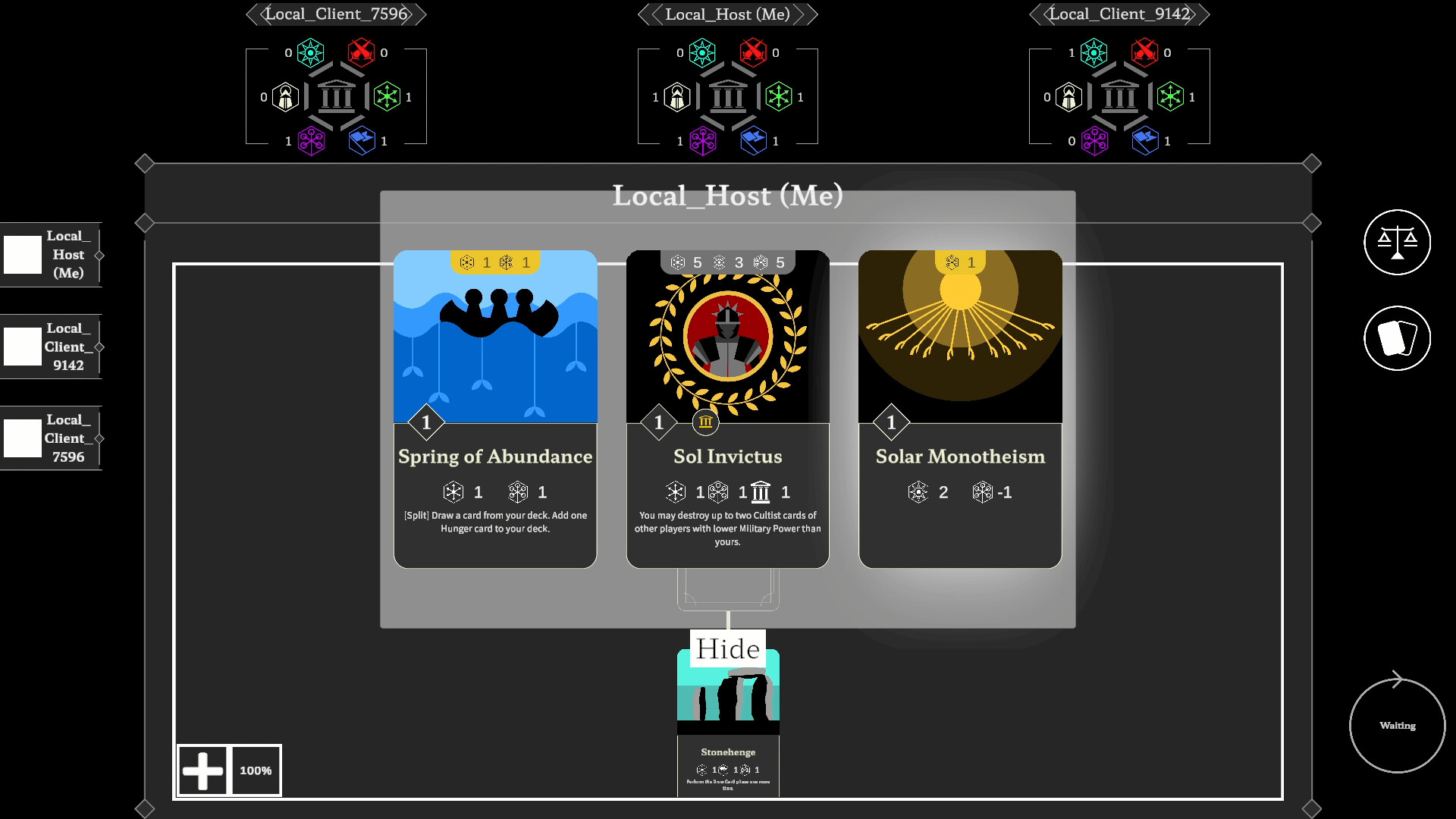
However, building your own deck will deepen your understanding of the cards and help to find unconventional strategies. A deck consists of 31 cards including 1 starting card, and you may include up to 3 copies of any given non-starting card. There are no other restrictions on card selection: you may use cards from a wide range of religious themes, or focus on a concentrated build. But be careful—if you don't check the required symbols, you may find that cards you've added to your deck can't actually be played. Always check the types and number of symbols a card provides, and consider whether they can meet the symbol requirements of your other cards.
A deck consists of 31 cards including 1 starting card, and you may include up to 3 copies of any given non-starting card. There are no other restrictions on card selection: you may use cards from a wide range of religious themes, or focus on a concentrated build. But be careful—if you don't check the required symbols, you may find that cards you've added to your deck can't actually be played. Always check the types and number of symbols a card provides, and consider whether they can meet the symbol requirements of your other cards.
Card Mechanics: Sacrifice and Destroy
Besides drawing additional cards, flipping cards produces various effects on the field, and you must consider these factors when building a deck.
Sacrifice
Some cards require Sacrifice. Sacrifice is performed on Cultist cards you own, and once triggered, the selected Cultist card is immediately destroyed. Cards and effects that can be used by sacrificing a Cultist card carry powerful effects capable of turning the tide of the game.
Destroy
Some cards have a direct impact on other players by destroying their Cultist cards. Because this is an extremely powerful mechanic, such cards may require additional conditions—for example, possessing greater Military Power than the opponent, or holding another combo card.
Don't worry. Cultist cards that have been sacrificed or destroyed are not removed from the game; they move into the trade pile, where they may be introduced to other players.
In addition, some cards carry various keywords, and these provide important information for play.
The [Split] keyword opens up space to form a new sect when the card is flipped. Through different sects, you can efficiently strengthen your religion and reduce the risks of certain cards. You can have up to 3 sects.
The [Feat] keyword is used on cards with very powerful effects, and only one such card may exist in a flipped state on a single player's field. Using these at the right moment is crucial.
The [Echo] keyword takes effect when an opponent declares destroy on this card while it is unflipped. In that case, instead of being destroyed, the card is flipped without cost and immediately provides a benefit to the player holding it. This is a powerful bluff, and punishes plays that destroy opponents' card.
The [Crisis] keyword triggers while the card is in the deck: if a card with this keyword appears during the Draw Cards phase, it must be selected.
The [Revelation] keyword triggers when deck have been exhausted; cards with this keyword can only be drawn one at a time, and once acquired, must be flipped immediately to use their effect.
Cards with the [Sacrifice] keyword require sacrificing another Cultist card in order to be flipped.
Ultimately, you must build a powerful deck that can win either by completing the Pantheon or by eliminating all of the other players' Cultist cards.
Symbols and the Pantheon
The cards have various symbols matching their contents and effects. Each symbol is one of the following: Influence, Unity, Polytheistic, Monotheistic, or Military Power. These respectively indicate how expansionistic a religion is, how politically unified it is, how strongly polytheistic or monotheistic it is, and how militarily strong it is.
To flip and activate most cards, you must possess enough of these symbols. The top portion of a card shows the types and number of symbols required, while the bottom shows the types and number of symbols you gain by holding the card flipped. These symbols do not disappear while the card is held flipped; they are considered continuously possessed.
Monotheistic
Monotheistic cards consist mainly of Abrahamic religions and the cards that influenced them. Compared to polytheistic cards, they have a more exclusive character; they grow stronger as the game progresses, but the symbols they require also increase steeply. Late-game cards generally have high Military Power and make it easy to win by destroying opponents' Cultists. However, gaining Pantheons is difficult. Early-game cards are designed to defend opponents' interference and enable steady growth.
Polytheistic
Polytheistic cards consist of different faiths from various cultural regions. They appear separately in the early stages, but as the game progresses they fuse together and develop composite divinities. In the game, polytheistic cards have relatively low symbol requirements but come with various restrictive conditions. Resolving these restrictions may require using cards with different religious cultures together. The low symbol requirements buy time to score cards from other religious cultures. Victory is typically achieved by gaining Pantheons with the powerful combo play.
Unity
Unity indicates how well a religion can rally its members together. A religion with high Unity manages the dissatisfaction of its members and makes remarkable feats possible through individual sacrifice. In the game, Unity is allotted to cards representing exclusive religious cards whose growth is driven by strong cohesion. Most cards that require Unity have a high-risk, high-reward structure, and are designed to enable rapid, aggressive development based on a few key cards.
Influence
Influence indicates how expansionistic a religion is. An open religion that spreads explosively in a short period of time can be considered a religion of high Influence. In the game, Influence is concentrated on the cards of religions that have continuously changed by absorbing other cultures, rather than religions that grew through internal cohesion. Cards that require Influence do not produce powerful effects in a short time, but they stabilize the card supply and can demonstrate their effect when combined with other cards over the long term.
Military Power
Military Power indicates how much influence one can project over other religious communities. A player with strong Military Power can interfere more frequently with other players. They can destroy Cultist cards, restrict certain plays, and gain more advantages in turn order. Because Military Power cards are divided among cards of different religious cultures, achieving high Military Power may require various kinds of symbols. They are not distributed evenly and the timing at which they can be acquired also differs, so they must be considered first when designing a deck.
Pantheon
Some cards possess feats and influence that endure through the passage of time. These are represented by a temple-shaped Pantheon icon, and holding seven or more allows you to win after the end of a turn. Unlike other symbols, Pantheons are not required to activate cards, but they are necessary for victory, which can make them relatively difficult to acquire.
In the game there are diverse beliefs and the diverse religions that can be built from them. These religions are not sharply distinguished from one another and may follow different historical trajectories depending on the players' moment-to-moment choices that may be either constructive or self-destructive. The various ideas are contained within the cards.
Can you outgrow the world that contains yourself and become much bigger?
スクリーンショット
評価・レビュー
全体レビュー レビュー不足または未評価 好評率 50.00% / 4件 取得:2026年9月3日 13:46
ATTENTION
注目度メトリクス
プレイヤー推移
データ蓄積中 24時間平均選択した期間に観測データはありません。
Steamフォロワー推移
2件以上で集計 直近7日選択した期間に観測データはありません。
プレイヤー数とフォロワー数は意味と単位が異なるため、 別々の時系列として表示しています。補間した値は使用していません。
発売後注目度の基礎指標 発売済みタイトルのため、現在プレイヤー数・ピーク値・Steamフォロワー数を組み合わせて勢いを観測します。
| 指標 | 現在値 | 観測状況 |
|---|---|---|
| 現在プレイヤー数 | 0人 | 最終観測:2026年8月21日 23:57(37日経過) |
| 24時間ピーク | データ蓄積中 | 履歴あり・更新待ち・直近7日 0件 |
| Steamフォロワー数 | 31人 | 最終観測:2026年8月11日 11:14(47日経過) |
| 7日フォロワー増加 | 2件以上で集計 | 履歴あり・更新待ち・直近7日 0件 |
PlayMEXが保存した観測値です。取得時刻と観測数を あわせて確認できます。
ジャンル・機能
機能カテゴリ
オンラインPvPファミリーシェアリング
ゲームライフログ
所有ゲームとして同期されると、 このゲームの記録を残せます。