


GAME DETAIL
Road to Omaha: College Baseball Dynasty
種別:ゲーム
発売日:2026年6月8日
日本語対応未確認
2,600円
Steamレビュー
やや好評
78.6%
14件
A deep college baseball dynasty management sim where you build a program across endless seasons: recruit, set lineups and rotations, hire staff, manage schedules, develop players, and play or sim every game pitch by pitch. Can you become the greatest coach of all time?
このゲームについて
Steamの詳しい説明を読む
Build a program. Build a career. Build an entire college baseball universe.
Road to Omaha is a data-driven college baseball dynasty management simulation built for players who love recruiting, roster construction, coaching strategy, player development, deep statistics, and the long-term challenge of turning a program into a national contender.
Take over an established powerhouse, rebuild a struggling program, or begin your coaching career at a lower level and work your way up. Recruit your roster, hire your staff, develop players, manage every pitch, and leave a legacy that can span decades.
Choose the Size of Your Baseball World
Play the focused Division 1 experience or expand your save into a connected universe containing as many as 1,565 programs.
Classic Universe: Approximately 300 Division 1 programs
Expanded Universe: 1,170 four-year programs across Division 1, Division 2, Division 3, and NIAA
Full Universe: 1,565 programs across every four-year level and three JUCO divisions
Every division has its own conferences, standings, polls, statistical leaders, awards, schedules, finances, and national championship. Players, coaches, recruits, transfers, and draft prospects still inhabit one connected baseball world.
Move between divisions whenever you want, follow lower-level stars, watch coaches climb the profession, and see overlooked players develop into legitimate top-level prospects.
Build Your Program Your Way
Every season begins with the decisions made away from the field. Balance immediate needs against the long-term health of your program as you construct a roster, hire assistants, manage finances, and invest in facilities.
Build around power, speed, defense, pitching depth, player development, analytics, or any identity that fits the program you want to create.
Manage lineups, rotations, bullpen roles, depth charts, and travel squads
Hire and develop coaches with distinct skills, philosophies, and career goals
Upgrade facilities with meaningful development, health, scouting, and financial effects
Handle injuries, morale, transfers, draft decisions, and roster turnover
Build program prestige within your division
Pursue better coaching jobs or build a lasting dynasty at one school
Recruit in One Connected Player Market
High school recruits and transfer players evaluate more than a simple prestige number. Playing time, development, coaching, geography, facilities, financial fit, relationships, and professional opportunities all influence where a player wants to go.
Scouting reports include uncertainty, confidence, evaluation disagreement, and rating ranges that narrow as your staff learns more. Potential is an estimate—not a perfectly known ceiling.
CPU programs recruit from the same player pool and operate under their own roster needs, budgets, scouting knowledge, pipelines, and program limitations.
Recruit high school prospects and transfer players
Discover players through regional pipelines, camps, showcases, video, and coach networks
Scout current ability, projection, maturity, signability, and professional interest
Compete against programs from every enabled level
Convince players to stay or replace them through the portal
Watch players transfer up, down, or laterally throughout the baseball universe
Develop Players With Real Variety
Player development is shaped by coaching, facilities, age, role, repetitions, work ethic, health, physical growth, adaptability, and controlled randomness.
Some players become stars immediately. Others stall, decline, break out late, change positions, add pitches, or emerge from a lower division as legitimate professional prospects.
The underlying rating system supports meaningful comparisons across every level. The familiar 20–80 scouting scale remains the recommended display, with optional precise 20–80, 1–100, and 1–1000 formats.
Expanded hitting, pitching, fielding, catching, baserunning, and athletic ratings
Separate current ability, potential, scouting confidence, and uncertainty
Individual training, fall practice, mentorship, conditioning, and defensive development
Detailed pitch repertoires with individual stuff, movement, command, usage, confidence, and potential
Complete player histories covering development, injuries, awards, transfers, and draft outcomes
Coach True Pitch-by-Pitch Baseball
Every game runs through the same true pitch-by-pitch baseball engine—whether you coach it yourself, watch it, instantly simulate it, or let it play in the background.
Call individual pitch types and locations. Choose offensive approaches. Send runners. Shift the defense. Manage fatigue, leverage, matchups, substitutions, and the bullpen.
Your decisions influence the odds without guaranteeing an outcome. A good bunter can still miss. A fast runner can get a bad jump. A well-located pitch can still be hit. Baseball remains unpredictable.
Call pitch types and target locations
Use normal, contact, power, or take approaches
Call steals, hit-and-runs, sacrifice bunts, bunts for hits, and squeeze plays
Use shifts, infield positioning, no-doubles defense, pitchouts, and intentional walks
Control pitching changes, mound visits, pinch hitters, pinch runners, and defensive substitutions
Advance one pitch, one plate appearance, one half-inning, one inning, or the remainder of the game
Leave an active game and resume it later without losing progress
Face Managers With Different Ideas
CPU managers use the same tools available to the player. They build matchup lineups, choose starters, set bullpen availability, adjust defensive assignments, call offensive plays, and react to the game as it unfolds.
Coaches differ in aggressiveness, bunting, stealing, hit-and-run usage, bullpen management, platoon preferences, defensive shifting, patience with struggling players, and reliance on analytics.
Better coaches read situations more accurately, but they do not receive hidden knowledge or guaranteed outcomes.
See the Game Beneath the Score
Road to Omaha is built for players who love the statistical side of baseball.
Follow live win probability, leverage, run expectancy, pitch count, fatigue, upcoming hitters, pitcher repertoires, matchup history, recent form, times through the order, and spray tendencies while a game is being played.
Afterward, dig into traditional statistics, advanced metrics, complete box scores, pitch histories, batted-ball data, defensive performance, and the decisions that changed the game.
Traditional batting, pitching, fielding, catching, and baserunning statistics
Pitch location, velocity, command, swing, chase, contact, and whiff data
Exit velocity, launch angle, barrels, hard-hit contact, and batted-ball direction
WPA, RE24, expected hits, expected total bases, and expected offensive value
Putouts, assists, errors, fielding percentage, range factor, Outs Above Average, and Defensive Runs Saved
Catcher framing, blocking, passed-ball, stolen-base, and caught-stealing statistics
Season, career, postseason, and program history
Chase Championships at Every Level
Each division has its own schedule structure, financial environment, polls, computer rankings, awards, selection process, postseason field, and national championship.
Build weekend series and midweek schedules, manage travel and guarantee games, fight for conference position, follow the bubble, earn hosting opportunities, and navigate elimination baseball.
Postseason progress remains available throughout the dynasty interface, so you can explore other screens without losing your place in the tournament.
Follow a Living Baseball World
The universe continues moving beyond your own team.
Follow major games, upsets, milestones, injuries, recruiting classes, transfers, draft results, awards, coaching changes, rivalries, postseason rematches, record chases, program eras, alumni, and “Where Are They Now” stories.
Players and coaches retain their histories as they move through the sport. Lower-level stars can transfer upward. Assistants can become head coaches. Successful coaches can climb through the divisions, while struggling programs face financial and competitive pressure.
Built for Long-Term Dynasties
Road to Omaha is designed to preserve the history that makes a dynasty matter.
Complete season and career totals remain permanent across deep saves. Important games retain detailed pitch histories, while older background data can be compacted without deleting the statistical record. Players who want maximum detail can choose to archive every pitch.
Faster incremental saving, compressed save exports, and optimized large-universe systems help keep multi-decade worlds playable.
Customize Your World
Play with the fictional baseball universe included with the game or create your own.
Customize program names, abbreviations, colors, logos, conferences, stadiums, division names, poll names, postseason names, facilities, and postseason field sizes through editable data files.
Choose between light and dark themes, multiple rating displays, accessibility options, and interfaces designed for desktop, laptop, tablet, and phone-sized screens.Key Features
College baseball dynasty management across unlimited seasons
Three universe sizes containing approximately 300 to 1,565 programs
Division 1, Division 2, Division 3, NIAA, and three JUCO divisions
Separate schedules, standings, polls, statistics, awards, and championships for every division
Connected recruiting, transfer, coaching, development, and professional draft systems
True pitch-by-pitch simulation in coached, watched, instant-sim, and background games
Detailed offensive, pitching, bullpen, substitution, and defensive strategy
Distinct manager personalities and coach-driven CPU decision-making
Deep player and coach ratings with scouting uncertainty and multiple display scales
Traditional and advanced batting, pitching, fielding, catching, and baserunning statistics
Complete player, coach, team, conference, postseason, and universe history
Program finances, facilities, stadium condition, recruiting reach, and staff payroll
Full light and dark themes with responsive layouts
Gamepad and Steam Input support
Editable fictional universe and sandbox customization tools
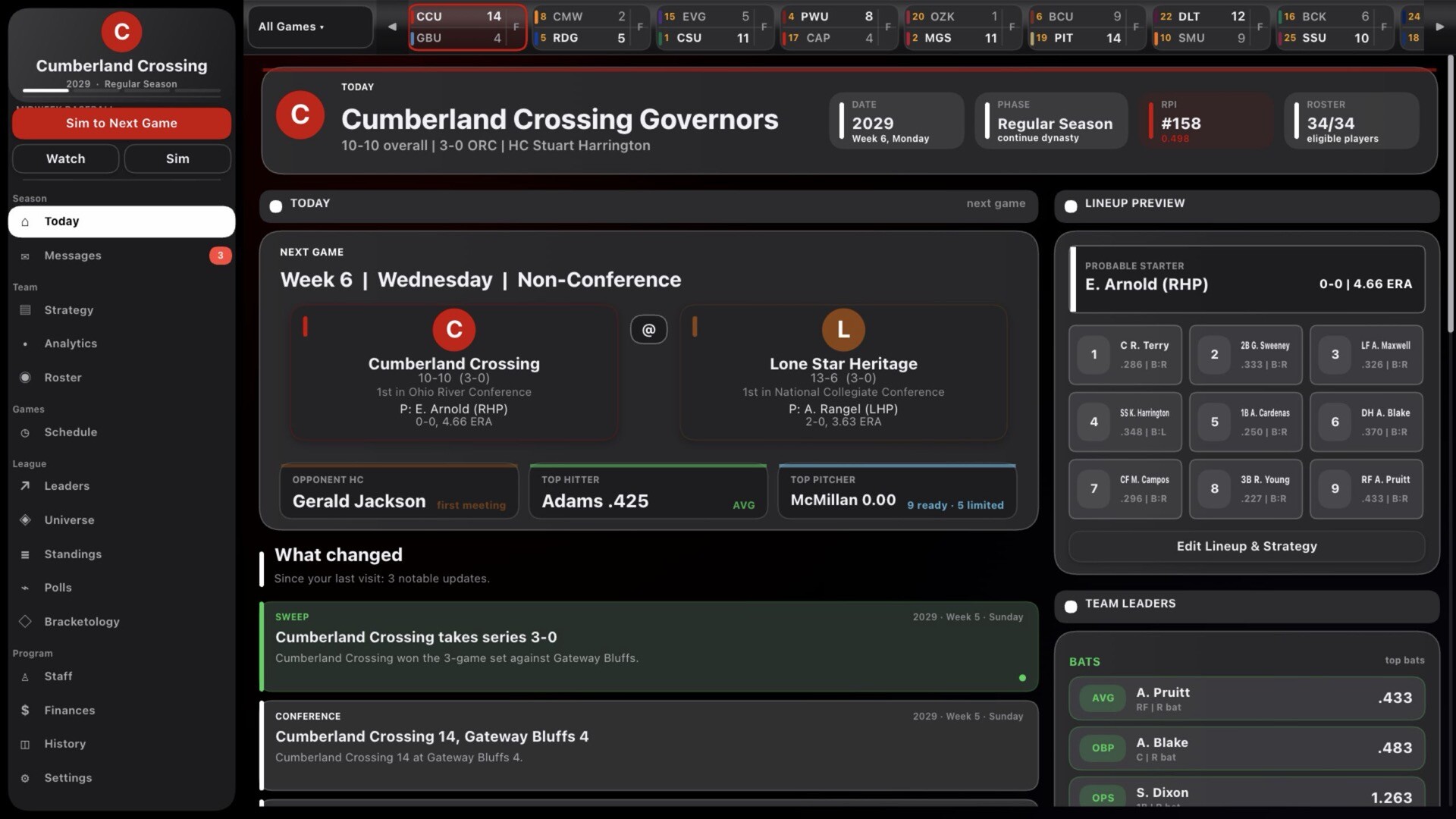
Road to Omaha is a management simulation, not an arcade action game. Games are presented through live data, strategy controls, play-by-play, scouting information, and statistical analysis.
スクリーンショット
評価・レビュー
全体レビュー やや好評 好評率 78.57% / 14件 取得:2026年9月3日 01:26
ATTENTION
注目度メトリクス
プレイヤー推移
データ蓄積中 24時間平均選択した期間に観測データはありません。
Steamフォロワー推移
2件以上で集計 直近7日選択した期間に観測データはありません。
プレイヤー数とフォロワー数は意味と単位が異なるため、 別々の時系列として表示しています。補間した値は使用していません。
発売後注目度の基礎指標 発売済みタイトルのため、現在プレイヤー数・ピーク値・Steamフォロワー数を組み合わせて勢いを観測します。
| 指標 | 現在値 | 観測状況 |
|---|---|---|
| 現在プレイヤー数 | 2人 | 最終観測:2026年8月22日 14:40(33日経過) |
| 24時間ピーク | データ蓄積中 | 履歴あり・更新待ち・直近7日 0件 |
| Steamフォロワー数 | 48人 | 最終観測:2026年8月19日 15:51(36日経過) |
| 7日フォロワー増加 | 2件以上で集計 | 履歴あり・更新待ち・直近7日 0件 |
PlayMEXが保存した観測値です。取得時刻と観測数を あわせて確認できます。
ジャンル・機能
機能カテゴリ
#category_playable_at_your_own_paceSteamクラウドSteamワークショップSteam実績いつでもセーブ可能シングルプレイヤータブレットでRemote Playテキストサイズの調整テレビでRemote Playファミリーシェアリングフルコントローラサポートマウスのみのオプション
ゲームライフログ
所有ゲームとして同期されると、 このゲームの記録を残せます。