
GAME DETAIL
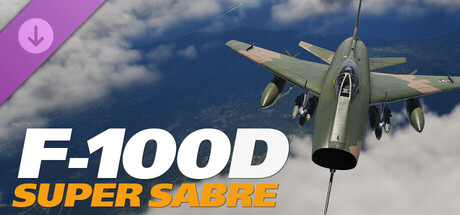
DCS: F-100D Super Sabre by Grinnelli Designs
種別:DLC
発売日:2026年6月12日
日本語対応未確認
5,858円
Steamレビュー
好評
97.3%
37件
Flying the F-100D Super Sabre in DCS is a demanding, hands-on experience that leaves little room for complacency. From managing its high-speed handling characteristics to understanding early-generation avionics, every phase of flight requires focus and discipline.
このゲームについて
Steamの詳しい説明を読む
The F-100D Super Sabre entered service in 1956 as the U.S. Air Force’s definitive fighter-bomber. Succeeding the legendary F-86, it was the first fighter aircraft capable of supersonic speed in level flight. Although developed as a day air-superiority fighter, the Super Sabre family eventually saw the F-100D repurposed as a ground-attack platform. Extensive use of the F-100D during the Vietnam War made it the most widely produced variant.
Building on the legacy and performance of its predecessor, the F-100’s distinctive 45-degree swept-wing design introduced unique handling challenges at low speeds. In particular, inexperienced pilots could encounter the notorious “Sabre Dance”: A phenomenon resulting from increasing adverse yaw, inertial coupling, and wing-tip stall.
The Super Sabre is equipped with four 20 mm Pontiac M39 cannons mounted in the lower fuselage beneath the cockpit, providing formidable firepower. It is capable of carrying up to four AIM-9 Sidewinder air-to-air, infrared-guided missiles for targeting enemy aircraft. The aircraft also features six underwing hardpoints that can carry a total payload of up to 7,040 lb of conventional bombs, rockets, napalm, and the AGM-45 Shrike anti-radiation missile used to attack radar installations. To support both aerial gunnery and air-to-ground bombing, the aircraft is equipped with a fire control system that helps the pilot accurately aim and release weapons.
To further enhance operational effectiveness, the F-100D features the “high wire” modification that standardizes instruments and avionics. This includes the AN/APR-25 Radar Homing And Warning receiver (RHAW), which alerts pilots to threats from surface-to-air missiles (SAMs). For example: The RHAW can detect radar emissions from systems like the Fan Song tracking radar that guides SA-2 Guideline missiles.
Key Features of the DCS: F-100D Super Sabre:
Highly detailed cockpit and external model: Crafted from thousands of photos, photogrammetry, and laser scans of an F-100D museum aircraft.
Extremely accurate flight model (EFM): Tested against actual short- and long-period dynamics reports to achieve exact handling qualities that have also been verified by actual F-100 pilots.
Detailed era-correct F-100D pilot model
Zero-length launch: A rocket-mounted system for launching the aircraft from a standstill with a full combat payload.
Configurable strike and gun cameras: Record weapons fire so that pilots can review in debriefs.
Customizable dash: Set up core gauges the way you want them, or randomize the setup for an authentic experience.
High-quality cockpit audio: Recorded from an actual F-100.
In-depth systems modeling:
Electrical system: A fully-simulated electrical system model provides accurate voltages, currents, and power consumptions of electrical components.
Hydraulic system: Simulates hydro-mechanical flow and physically modeled actuators.
Radio navigation equipment: Including UHF Radio direction finding, ADF, and TACAN.
Thermodynamic engine model: Includes engine compressor stalls and surges, oil, gearbox, ignition, and afterburner physics.
Multiple probe and afterburner configurations: Integrated into the flight and engine models. Two afterburner models are provided: The J-57-P-21 and J-57-P-23. Pilots flying the older J-57-P-21 experience longer afterburner light times, more frequent failures to light, and more frequent compressor stalls.
Physical simulation of pilot interfaces: Including gauges, friction, and mass to achieve realistic dynamics on gauges and other moving parts.
Temperature simulation of aircraft brakes: Includes brake fade and smoke when brakes are too hot.
Radar homing and warning receiver: Includes detailed radar signal simulation, dynamically generated unique sounds for all radar units, and a scope that displays radar vectors for three specific threat bands.
Detailed weapon systems: Includes guns, air-to-air missiles (including new AIM-9E Sidewinder), air-to-ground missiles (AGM-45 Shrike), bombs, rockets, and two new cluster dispensers (CBU-38 and CBU-7).
Fire control system: Incorporates a ranging radar, gyroscopic air-to-air gunsight, and an early form of computer-assisted bombing.
Detailed dynamic damage: Supported by in-depth system modeling.
In-game manual: To help you learn in the cockpit. Offline manuals are also provided.
Interactive training missions: Five training missions at launch, and more after launch. Instant Action missions for various maps, including but not limited to Caucasus and Marianas.
Flying the F-100D Super Sabre in DCS is a demanding, hands-on experience that leaves little room for complacency. From managing its high-speed handling characteristics to understanding early-generation avionics, every phase of flight requires focus and discipline. In the DCS: F-100D Super Sabre, success comes from understanding its nuances, and this makes it a deeply rewarding aircraft to master for those up to the challenge.
スクリーンショット

評価・レビュー
全体レビュー 好評 好評率 97.30% / 37件 取得:2026年9月2日 19:30
日本語レビュー レビュー不足または未評価 好評率 100.00% / 1件 取得:2026年9月2日 19:30
ATTENTION
注目度メトリクス
プレイヤー推移
データ蓄積中 24時間平均選択した期間に観測データはありません。
Steamフォロワー推移
2件以上で集計 直近7日選択した期間に観測データはありません。
プレイヤー数とフォロワー数は意味と単位が異なるため、 別々の時系列として表示しています。補間した値は使用していません。
発売後注目度の基礎指標 発売済みタイトルのため、現在プレイヤー数・ピーク値・Steamフォロワー数を組み合わせて勢いを観測します。
| 指標 | 現在値 | 観測状況 |
|---|---|---|
| 現在プレイヤー数 | 未集計 | 最終観測:未集計 |
| 24時間ピーク | データ蓄積中 | 未集計・直近7日 0件 |
| Steamフォロワー数 | 未集計 | 最終観測:未集計 |
| 7日フォロワー増加 | 2件以上で集計 | 未集計・直近7日 0件 |
PlayMEXが保存した観測値です。取得時刻と観測数を あわせて確認できます。
ジャンル・機能
機能カテゴリ
LAN PvPLAN協力プレイPvPオンラインPvPオンライン協力プレイキャプション使用可能シングルプレイヤーダウンロードコンテンツマルチプレイヤーレベル編集可能協力プレイ
ゲームライフログ
所有ゲームとして同期されると、 このゲームの記録を残せます。