
GAME DETAIL
Medieval Travelling Merchant
種別:ゲーム
発売日:2026年8月13日
日本語対応未確認
790円
Steamレビュー
レビュー不足または未評価
100.0%
1件
Travel across a living medieval economy, buy goods where supply is strong, and sell where demand creates opportunity. Manage cargo, routes, escorts, seasonal markets, rival merchants, and risk in a focused, relaxing trading simulation.
このゲームについて
Steamの詳しい説明を読む
Medieval Travelling Merchant is a focused trading simulation built around a living medieval economy.
Travel between villages, towns, cities, a great city, and the royal capital. Buy goods where supply is abundant, carry them across the realm, and sell where local demand creates a profitable opportunity.
There is no combat system, crafting tree, city management, or kingdom building competing for your attention. The core of the game is trade: observing markets, managing capital, choosing routes, controlling risk, and adapting when conditions change.
A Living Economy, Not a Random Price Generator
Markets do not simply roll arbitrary prices whenever you arrive.
Each settlement maintains its own stock, production, consumption, and demand conditions. Prices respond to the actual economic state of that market:
Local production increases supply.
Residents consume goods as time passes.
Population, occupations, wealth, and settlement type shape demand.
Player purchases reduce available stock.
Player sales increase stock and can create market saturation.
Rival merchants buy, transport, and deliver goods between settlements.
Seasons and local events can disrupt production, supply chains, travel, and demand.
This creates real relationships between supply, demand, scarcity, surplus, inventory levels, market depth, price movement, and diminishing returns.
A profitable market may become less attractive after a large delivery. A shortage may recover over time. A familiar route may lose its margin after repeated sales, while another settlement develops a new opportunity.
The economy continues to operate even when the player does nothing.
Buy Low, Sell High — But Watch the Margin
Every product has a market price shaped by current conditions.
Markets can show:
Surplus, where goods are plentiful and buying opportunities are stronger.
Balanced supply, where prices remain closer to normal.
Shortage, where demand may support more profitable sales.
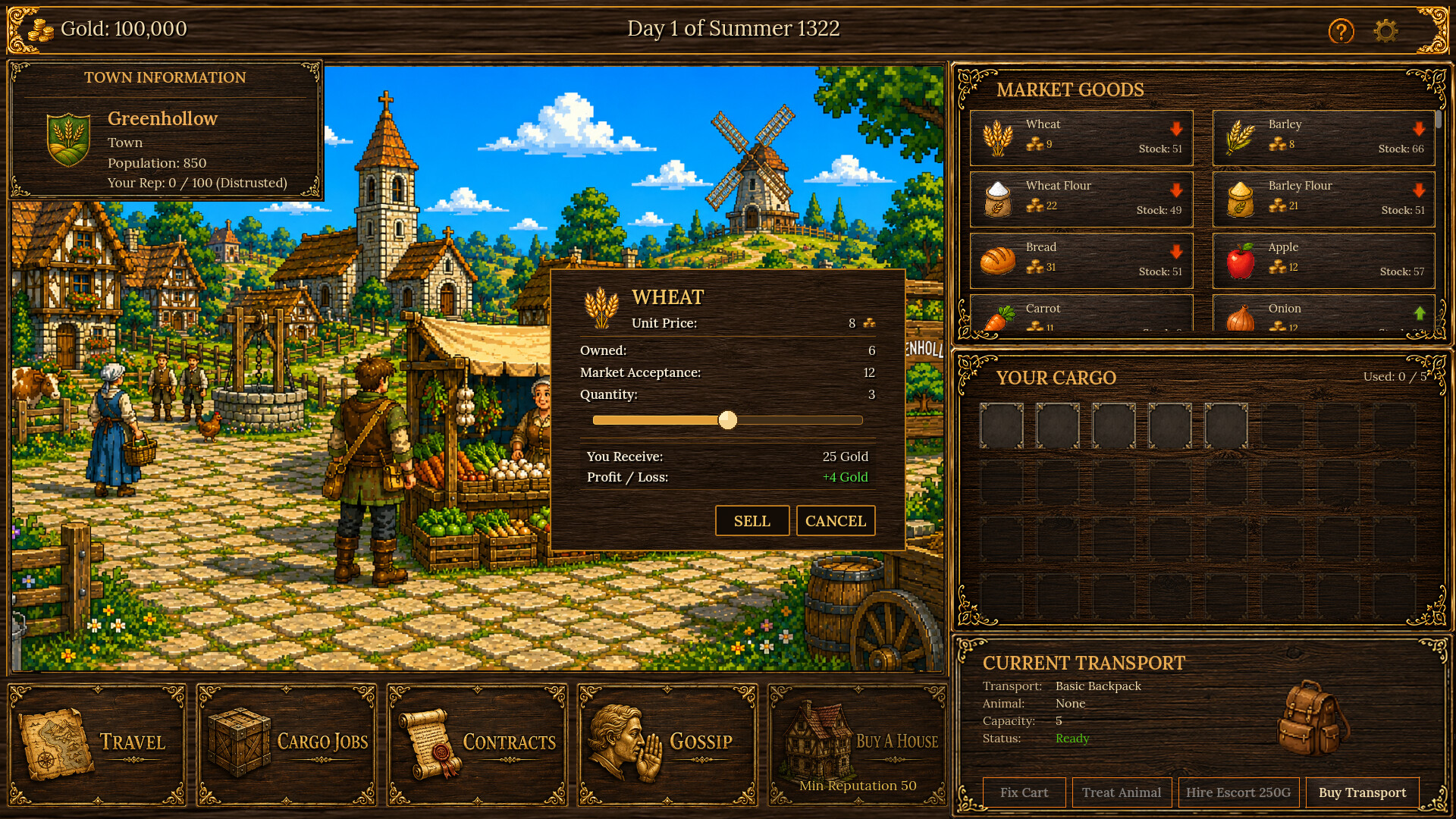
Large trades are priced progressively. Selling twenty units is not the same as selling one unit twenty times at the same price. As the market absorbs your cargo, later units may earn a smaller margin—and excessive supply can eventually turn a profitable sale into a loss.
That makes quantity part of the decision.
Sometimes the best move is to sell only part of your cargo. Sometimes it is worth accepting a small loss to free capacity for a better opportunity elsewhere.
125 Goods Across 10 Distinct Markets
Trade a broad range of medieval goods, including:
Grain, flour, bread, meat, dairy, and preserved food
Timber, ore, metal bars, tools, and construction materials
Cloth, clothing, leather goods, and transport supplies
Wine, ale, tea, spices, oil, and glassware
Books, jewellery, gemstones, perfumes, noble clothing, and luxury goods
Each settlement has its own economic identity.
Farming communities, mining towns, forest settlements, ports, manufacturing cities, wealthy urban markets, and the royal capital do not produce or consume the same mix of goods.
Local culture and social structure also matter. Labourers, farmers, miners, craftsmen, merchants, guards, wealthy citizens, and nobles create different patterns of consumption.
The handbook inside the game explains these market identities without revealing exact hidden formulas or guaranteed trade routes.
Rival Merchants Compete for the Same Economy
You are not the only trader on the road.
Other merchants move across the world map using different animals, carts, capacities, route preferences, and economic profiles. They purchase goods, deliver cargo, reduce shortages, and sometimes reach a market before you do.
A route that looked profitable when you departed may be less attractive by the time you arrive.
Rival merchants do not exist only as visual decoration. Their completed trades change market stock and affect the opportunities available to you.
Four Seasons, Changing Conditions
Spring, summer, autumn, and winter change both the appearance of the world and the rhythm of trade.
Seasonal conditions can affect:
Agricultural and animal production
Availability of stored and processed goods
Demand for food, fuel, clothing, and supplies
Road conditions and travel delays
The reliability of certain routes
Seasonal tendencies create opportunities, not guarantees. Current stock, recent deliveries, local demand, and unexpected events still matter.
Manage Capital, Cargo, and Risk
Your money is not useful only while sitting in your purse.
Capital can be tied up in:
Cargo
Transport upgrades
Animals and carts
Escorts
Toll payments
Houses
Repairs and treatment
Jobs and contracts
Expensive cargo may offer higher potential profit, but it also exposes more wealth to the road.
Escorts reduce danger, but protection has an ongoing cost. Hiring two guards may save a valuable shipment—or may reduce your net profit on an uneventful journey.
There is no universally correct choice. A short, inexpensive route may not justify protection. A long journey carrying luxury goods may justify a larger security expense.
Upgrade Your Transport
Begin with limited carrying capacity and gradually improve your operation.
Different transport setups offer different balances of:
Cargo capacity
Travel speed
Cost
Durability
Weather resistance
Risk exposure
A larger cart allows larger trades, but only when your capital, route planning, and target market can support the additional cargo.
More capacity is an opportunity, not an automatic profit multiplier.
Jobs, Contracts, Houses, and Progression
Free trading remains the heart of the game, but additional opportunities are available.
Cargo Jobs provide sealed cargo and a fixed payment for successful delivery.
Trade Contracts require you to purchase the requested goods with your own money and deliver them before the deadline.
Houses act as long-term investments and progression milestones across the realm.
New settlements and wider trading opportunities open as your merchant career develops, but the game remains focused on the same central activity: building wealth through trade.
A Calm Game With Meaningful Decisions
Medieval Travelling Merchant is designed to be thoughtful rather than frantic.
Travel across seasonal landscapes, listen to medieval-inspired music and market ambience, watch other merchants move between settlements, and study how prices develop over time.
The atmosphere is relaxed, but the economy still asks you to make real decisions:
Is the margin large enough to justify the distance?
How much should you sell before saturation weakens the price?
Is an escort worth the expense?
Should you carry expensive luxury goods or safer everyday products?
Is the current opportunity strong enough, or should you preserve your capital?
Just trade. Just chill.
Why I Made This Game
I have loved trading simulation games for years, but I often struggled to find one focused entirely on trade.
Many games include trading as one system among combat, crafting, city building, survival, or role-playing mechanics. I wanted something different: a game centred on markets, prices, cargo, routes, risk, and a genuinely simulated economy.
I wanted settlements with real stock and consumption. I wanted supply and demand to react to player activity. I wanted rival merchants to participate in the same economy. I wanted repeated sales to create saturation instead of producing unlimited profit from a fixed route.
So I began developing Medieval Travelling Merchant as the trading game I wanted to play myself.
I later decided to release it on Steam in case other players were looking for the same kind of focused, relaxing, economy-driven trading experience.
スクリーンショット
評価・レビュー
全体レビュー レビュー不足または未評価 好評率 100.00% / 1件 取得:2026年8月26日 20:57
ATTENTION
注目度メトリクス
プレイヤー推移
データ蓄積中 24時間平均選択した期間に観測データはありません。
Steamフォロワー推移
2件以上で集計 直近7日選択した期間に観測データはありません。
プレイヤー数とフォロワー数は意味と単位が異なるため、 別々の時系列として表示しています。補間した値は使用していません。
発売後注目度の基礎指標 発売済みタイトルのため、現在プレイヤー数・ピーク値・Steamフォロワー数を組み合わせて勢いを観測します。
| 指標 | 現在値 | 観測状況 |
|---|---|---|
| 現在プレイヤー数 | 0人 | 最終観測:2026年8月29日 09:28(30日経過) |
| 24時間ピーク | データ蓄積中 | 履歴あり・更新待ち・直近7日 0件 |
| Steamフォロワー数 | 23人 | 最終観測:2026年8月27日 04:27(32日経過) |
| 7日フォロワー増加 | 2件以上で集計 | 履歴あり・更新待ち・直近7日 0件 |
PlayMEXが保存した観測値です。取得時刻と観測数を あわせて確認できます。
ジャンル・機能
機能カテゴリ
ファミリーシェアリング
ゲームライフログ
所有ゲームとして同期されると、 このゲームの記録を残せます。