
GAME DETAIL
Ode to War
種別:ゲーム
発売日:2027年
日本語対応未確認
価格未定
A civilization MMO: from a single town to a galactic empire. The server ticks once an hour and keeps running while you sleep. You administer towns, not a nation, so each one holds its own stores and anything you need from a neighbor has to be traded for.
このゲームについて
Steamの詳しい説明を読む
Ode to War is a slow multiplayer strategy game about running settlements on a shared planet. The server advances once an hour. You are not meant to sit in front of it: you give your towns something to do, close the game, and come back to find out what the world did without you.
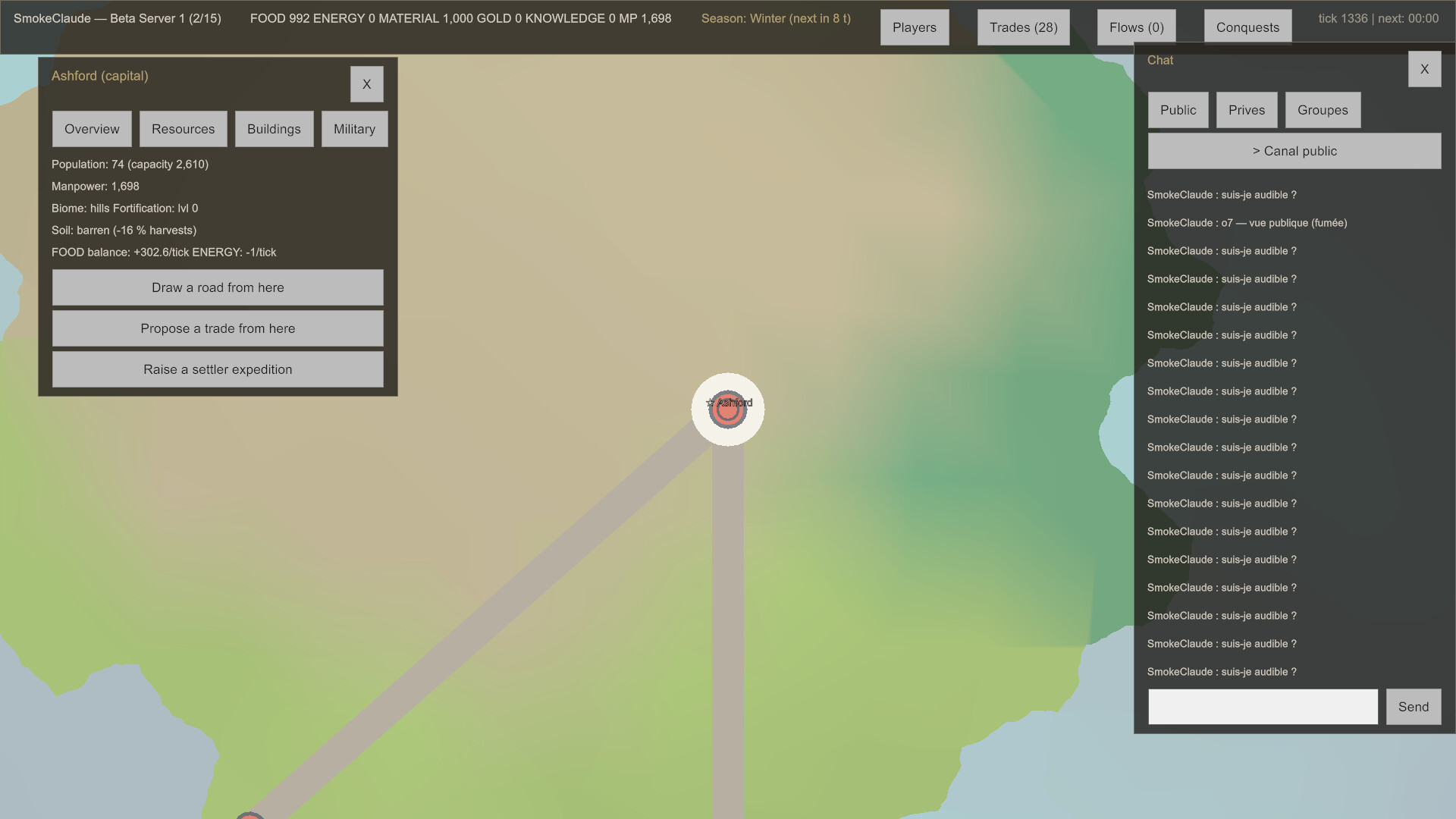
You do not play a nation. You play an administrator. Every settlement you found keeps its own granary, its own quarry output, its own workforce. There is no national treasury to spend from, so a town that runs out of timber cannot draw on some shared pool. It has to get timber from somewhere, and somewhere usually means someone.
One planet, generated not drawn
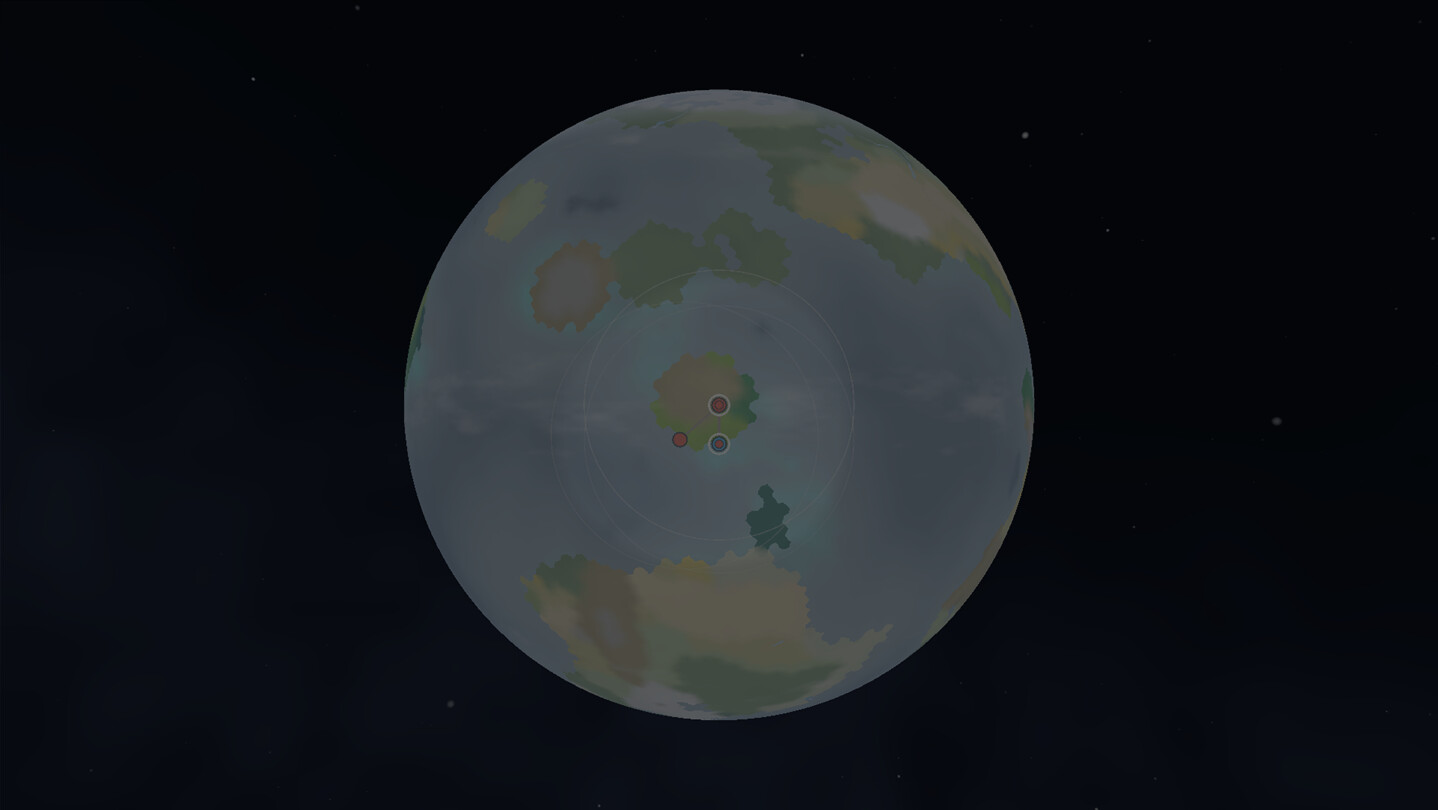
Each server has a single world and everyone plays on it. It is a sphere, and it is built by simulation rather than by hand. Plate boundaries raise mountains and open rifts. Prevailing winds carry moisture inland until the reliefs wring it out, which is why one side of a range is forest and the other is steppe. Ocean currents warm one coast and starve the one facing it. Rivers cut their valleys, and some of them die in a salt pan before they ever reach the sea.
None of that is decoration. Where you settle decides what you can grow, what you can dig up, and how expensive it will be to reach anybody else.
Seasons last a real week. The hemispheres are opposed, so a bad harvest in the north is a selling opportunity in the south. Winter freezes ports and slows armies on the march.
Trade is the only lever
There is one way to move anything between two players: propose an exchange. Goods, workers, even an entire settlement can change hands. Both sides see the terms before anyone agrees, and what you offer is held aside until the answer comes back.
Distance costs. Two towns joined by a built road, a navigable river or a sea lane trade cheaply. Two towns separated by a mountain range do not. Roads are laid by hand, waypoint by waypoint, and paid for in materials and labour, which means a trade route is a real investment and a real thing to lose.
War, when it comes to that
There is no declaration of war and no screen full of treaties. You set a stance towards each player, you forge weapons, you recruit a garrison or raise a field army, and you march it across terrain that slows it down and weather that starves it.
A siege you win leaves you a choice. Annex the town and administer it. Sack it, take everything, and leave the owner standing in the ruins. Or raze it, and let the survivors walk to whoever will take them in.
One planet, for now
The planet is not the end of it. It is the first tier.
The design ends with every planet sitting in the same universe, and the space between them opened up. A world that is a server today becomes a neighbour tomorrow. Reading terrain still matters, except a planet is now a position rather than a world, and the reasons to want somebody else's ground scale accordingly.
That is why the ground is simulated this far down. Games where a planet is three numbers in a tooltip already exist, several times over. This one is being built the other way round: get one world genuinely right, then multiply it.
None of that is playable, and nothing above describes it as though it were. Everything you can do today happens on one planet. The space tier is the reason the planet is built the way it is, not a promise about next month.
What it is not
There are no computer opponents. Every road, every town and every army on the map was put there by another player.
It is not a game you can finish in an evening, and it does not reward being awake at three in the morning. An hour of thought once a day is a perfectly good way to play it.
Current state
Ode to War is in playtest. The full loop is in: found a town, build it up, connect it, research, trade, settle new ground, and fight over it. Balance is still moving, and the servers are small on purpose so that the people on them actually run into each other.
Roadmap
I am one person working on this, so there are no dates below. This is the order things are being worked on, and playtesting reorders it.
I am one person working on this, so there are no dates below. There are three tiers, and each one has to actually work before the next one starts.
Tier one — one planet
Where the game is now. What is left:
Standing orders. Tell a town what to do while you are away: recall the garrison if someone crosses the border, halt a shipment if the stockpile drops, retreat rather than lose an army.
Terrain deciding yields. The map knows the difference between river silt and scraped bedrock. Your farms mostly do not yet. This is the largest change still to come.
Making threats readable. When an army marches on you, you should be told, and you should see how many hours you have.
More reasons to need a neighbour. Salt only forms on the shores of closed inland seas, and not every world has one. There should be several things like that, so that no map produces a settlement able to supply itself with everything.
A cost to holding a lot of ground, and somewhere for a neglected province to take its grievance.
Tier two — a planet worth fighting over
Altitude entering combat and movement properly. It is simulated and currently spent almost entirely on how the map looks.
Industry moving the climate. Production shifts the climate bands over years of game time, moving good farmland towards the poles and forcing everyone to renegotiate who sells what to whom. It redistributes rather than punishes: the world does not get worse, it gets different.
Coasts and shipping doing more work. Sheltered harbours, open water, sea lanes cheaper one way than the other.
Tier three — the universe
The reason for all of the above. Every planet in one universe, the space between them opened, and empires that hold ground on more than one world.
Orbit as a real place above the map you already play on.
Travel and communication between worlds that take real time, so that a distant holding is genuinely distant and an empire has to be governed rather than merely owned.
Worlds that are not equivalent. A planet is a specific place with its own currents, harvests and shortages, not a slot with a modifier on it.
This is where the game is going. It is not where it is, and I will not pretend otherwise on a store page. Tier one is what you can play.
スクリーンショット
ATTENTION
注目度メトリクス
プレイヤー推移
データ蓄積中 24時間平均選択した期間に観測データはありません。
Steamフォロワー推移
2件以上で集計 直近7日選択した期間に観測データはありません。
プレイヤー数とフォロワー数は意味と単位が異なるため、 別々の時系列として表示しています。補間した値は使用していません。
発売前注目度の基礎指標 発売前タイトルのため、Steamフォロワー数と7日増加を中心に注目度を観測します。
| 指標 | 現在値 | 観測状況 |
|---|---|---|
| 現在プレイヤー数 | 未集計 | 最終観測:未集計 |
| 24時間ピーク | データ蓄積中 | 未集計・直近7日 0件 |
| Steamフォロワー数 | 2人 | 最終観測:2026年8月14日 05:14(42日経過) |
| 7日フォロワー増加 | 2件以上で集計 | 履歴あり・更新待ち・直近7日 0件 |
PlayMEXが保存した観測値です。取得時刻と観測数を あわせて確認できます。
ジャンル・機能
ジャンル
機能カテゴリ
ファミリーシェアリングマルチプレイヤー
ゲームライフログ
所有ゲームとして同期されると、 このゲームの記録を残せます。