
GAME DETAIL
SPOTREP
種別:ゲーム
発売日:2027年第1四半期
日本語対応未確認
価格未定
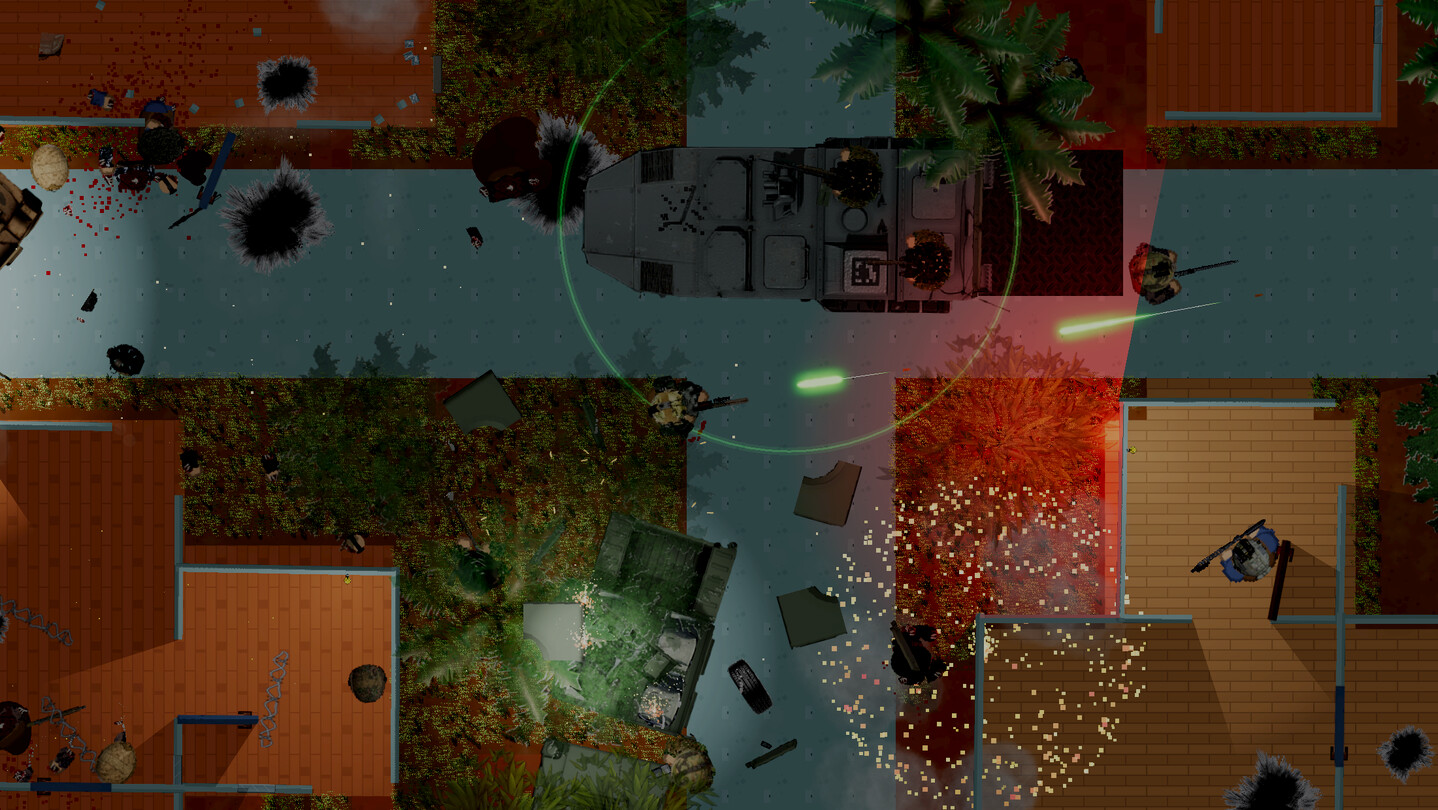
SPOTREP features MILSIM game mechanics, each dynamically changing how you play. Spotted a stationary target? Call in a GRG based CALL FOR FIRE including method of control and number of rounds. Your AI or player teammates are down? Call in a 4 liner MEDEVAC!
このゲームについて
Steamの詳しい説明を読む
Every system described below is simulated, not scripted. The fragmentation is individual fragments. The smoke is a polygon your enemies genuinely cannot see through. The wall you just breached, the artillery you called in, the claymore you placed, all shift how the enemies react and dynamically adjust their behaviour to players' actions.
FIRE SPREADS
Fire is not a decal. It starts, it grows, it travels, and it burns itself out.
Tracer rounds set things alight. The tracer cadence you loaded into that magazine is not cosmetic — a tracer passing through a curtain or across a carpet ignites it.
Explosions ignite too — grenades, claymores, artillery, rockets, the 30mm off the Apache. So does a burning corpse, an ammo cache cooking off, or a fuel barrel you shot.
Fuel barrels go in stages. The first hit punctures the drum and it vents a jet aimed back at whoever shot it. Then it catches. Then it goes up and leaves a fire behind.
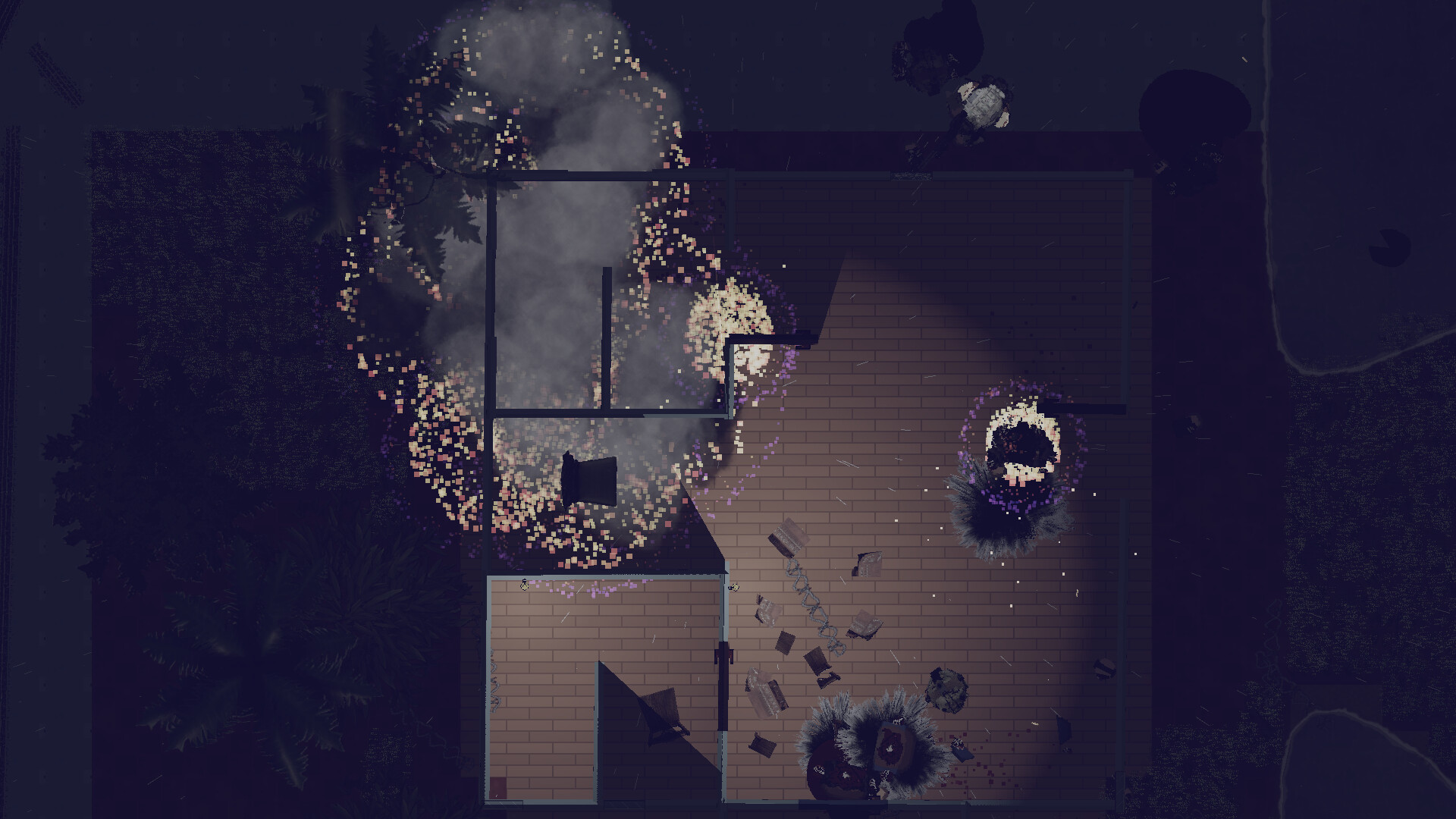
It spreads across wooden floors. A fire at full size walks to a new patch of timber a few metres away and starts again there, so a fire in one room becomes a fire in the house.
It burns what it touches — curtains, carpets, furniture, doors and timber walls each catch and start fires of their own rather than quietly losing health.
It hurts everyone. Players, your fireteam and the enemy all take damage standing in it. Vehicles do not.
The smoke chokes you. A burning building fills with smoke that feeds the medical model — stay in it and your breathing is a problem you will have to treat. It will also trip the house's own smoke alarm and tell everyone nearby exactly where you are.
It goes out on its own after about half a minute at full size. You cannot put it out, so the only decision is whether you go around.
BRAVO 5. THIS IS OBSERVER. ADJUST FIRE.
Every mission you are outnumbered, outgunned, players have to make proper decisions and choose when to use FIRE SUPPORTS to regain any possible advantage.
CALL FOR FIRE
The map is a real A-J by 0-9 grid, and each square subdivides again into a numbered keypad, and that keypad subdivides once more. You read the coordinate off the map and you type it onto a printed call-for-fire card — location, method of control, rounds, guns.
Adjust fire between volleys — add, drop, left, right, in fifty-unit corrections. The first rounds scatter. Corrected rounds land exactly where you put them.
At my command holds each volley until you release it. Fire when ready does not wait for anyone.
Your rounds are a limited pool, deducted one shell at a time as they are actually fired, so an abort costs you only what left the tube.
One fire mission at a time, match-wide, then a cooldown. The whole squad hears when the guns are free again.
MEDEVAC
When a man is down and not coming back on his own, you call it in on a four-line card, abridged from the real nine-liner: location, marked by, patients, enemy.
Your character reads the whole request over the radio, line by line, and the response tells you to pop smoke. You then have to actually mark the landing point — with the colour you said you would use, within reach of the grid you called. Fail to mark it in time and the mission aborts and you get your patient allocation back.
DO NOT LET THE GRAPHICS FOOL YOU
This is a top-down 2D game with a small pixel footprint, and the audio is not built to match. Every weapon, every impact, every radio transmission and every treatment was chosen for how the real thing actually sounds, not for how it reads on a sprite. Shots indoors run through a different sample and a real reverb bus. Outdoor shots throw a distant echo back across the map. Rounds passing over your head crack. Brass hits the floor. The radio procedure is spoken properly, line by line.
Play it with headphones. Half the information in this game arrives through your ears, and it was built that way on purpose.
TRAUMA MEDICINE, NOT HEALTH PACKS
Any source of damage has a chance to inflict a negative medical effect on a specific body part, impacting your character's performance, worsening over time if left untreated, resulting in falling into an unconscious state.
DO NOT WORRY ABOUT YOUR AI TEAMMATES, they will take care of themselves. But it's much more efficient to have a dedicated medical player who's into all this medical stuff, if you are playing singleplayer maybe it's time for you to invite your medic buddy from the service!
Blood volume drains from every open bleed until you stop it.
Blood pressure compensates, then crashes. Below the floor you black out regardless of anything else.
Oxygen falls from chest wounds, collapsed lungs and airway trauma.
Cardiac stress builds when you stack morphine against epinephrine. Overdose him and the heart stops.
Body temperature drops on a casualty who has been down and bleeding. Hypothermia is its own problem with its own treatment.
That readout is the whole game in one panel. HR 128 and climbing, BP 79/48, SpO2 86%, 3.9 litres of blood left out of 5.5, and a body that has gone cold. Nothing there tells you what to do. It tells you what is happening, and you work out the rest.
Diagnosis comes first. Wounds you have not diagnosed show as an unknown, not as a symptom. Run a diagnosis and the body chart resolves: yellow means undiagnosed trauma, red means you know exactly what it is. Walk too far from the patient and the vitals you read are forgotten.
Fourteen treatments, each with a right indication and a wrong one, sorted onto a radial you drive with the mouse. A tourniquet is the fastest fix on a limb and cannot be applied to a chest. A chest seal will not touch a collapsed lung — that needs a needle decompression. Breathing trouble with an intact chest means the airway, and you have to work that out yourself from the readout. Exit wounds take double applications. Epinephrine is always last, and only once everything else is fixed.
Treating yourself takes 30% longer. A dedicated medic works at half the time. Drag a casualty out of the open with your weapon holstered and your speed cut, or deploy a Casualty Collection Point and treat the whole team faster, for free, even when you are out of that supply.
EXPLOSIVES THAT THROW REAL FRAGMENTS
A grenade in SPOTREP is not a damage radius. It is 38 individual fragments, each one a real projectile with its own speed, its own travel limit and its own flight path through the world.
Cover actually works. Fragments are stopped by walls, doors and furniture, because they are objects that collide with them.
Fragments ricochet. Shallow angles bounce off walls at up to 80% chance and carry on at half damage. Head-on impacts never do.
Overpressure is separate. Large charges apply blast damage that does not care about walls at all — it falls off with distance from the centre and it will reach you through a partition that stopped every fragment.
Different explosives behave differently. A planted IED is pure blast with no shrapnel and draws its own kill radius on the ground. A claymore is a cumulative fan of fragments where every ray that reaches you stacks. A breaching charge is a shaped capsule that flattens what it is touching. A LAW is a direct-hit weapon. Artillery is the grenade model with three times the damage per fragment.
Blasts roll twice on the wound table where a bullet rolls once, and they are far more likely than gunfire to open an airway injury.
A WORLD YOU CAN TAKE APART
Wooden walls hole out under fire. Each panel is divided into segments and each segment fails on its own.
Destruction opens routes. When a wall dies the navigation mesh is rebaked. The hole you just blew is a path the enemy will use.
Sandbags stop most rounds, not all of them. Cover is probabilistic where cover is porous.
Fuel barrels go up in stages — punctured and venting, then burning, then gone, leaving a fire behind them.
Barbed wire does not stop you, it holds you: 70% speed loss, bleeding, and you cut it with bolt cutters or blow it with a grenade.
Furniture is pushable, breakable, and stops bullets while it is standing.
Sound is information, in both directions. Gunfire broadcasts a noise radius that scales with the weapon — a suppressed carbine reaches a fraction as far as a bolt-action rifle. Enemies who hear it may investigate, may just turn their head, or may put rounds through the closed door they think you are behind. Indoor shots run through a different sample and a real reverb bus, and a shot on a wooden floor can trip a smoke alarm in the house you are trying to clear quietly.
Your ears are damage-modelled. Firing indoors does double hearing damage. Past the threshold, tinnitus starts and everything else in the game ducks toward silence — the ringing is all you have left. Helmets mitigate it. It recovers slowly.
Magazine-level ammunition. You do not have ammo, you have magazines. Each one is a physical item in your chest rig with its own round count, its own tracer cadence and its own bullet core. Drop a partial mag in a firefight and it lands where you left it, still loaded, still yours to come back for.
A chambered round is its own round. Fire your last shot with a magazine seated and the bolt locks back. Seating a fresh magazine does not close it. You have to work the bolt release, or rack the charging handle, before the weapon will fire again.
A five-option reload menu — quick change, tactical change, chamber a round, check chamber, check magazine. Checking the chamber and checking your rig are real actions that take real time and tell you what you actually have.
Bullets are projectiles with travel time. Full metal jacket rounds punch through flesh, wood, glass and doors and keep going to hit the man behind. Hollow points hit harder and stop dead. Rounds ricochet off shallow angles at half damage.
Three attachment slots — muzzle, optic, tactical. Suppressors cut your noise radius by up to half and change what the AI hears. Compensators, brakes, ACOGs and holographics all move real numbers. The tactical rail takes weapon lights, IR illuminators, and visible or infrared lasers in four colours — each one a real light with a real beam, each one giving your position away to anyone who can see that spectrum.
Bipods are mandatory on machine guns. The M249, PKM and MX250 cannot be fired handheld. Deploying roots you in place inside a 25-degree traverse cone.
Night vision is a gear slot, not a class perk — four models up to a thermal overlay unit, each with rolled quality (GEN1-GEN3+) and field of view. Tubes down quadruple your minimum spread unless you have a holographic optic equipped or are using an IR LASER.
A silent knife takedown for when shooting is the wrong answer.
Some weapons are consumable. A grenade launcher or a bolt action long range sniper rifle is a line on the shop screen with a price and a weight — you buy it for the operation you think you need it on, and if you do not walk out with it, it is gone.
COMMAND YOUR OWN FIRETEAM
Every player recruits and commands up to three AI soldiers of their own — not shared with the squad, not host-only. Yours. They persist between operations, they carry their own gear and their own inventory, and they earn veterancy that measurably improves their reflexes, their accuracy, their recoil control and their resistance to suppression. Kill them and they are gone permanently, and the replacement you recruit inherits nothing.
Hold ALT and the world becomes a command overlay: numbers over your men, live health, live visibility, grenade counts, and their individual cones of fire.
Move with a drag — and drag further to set the direction they face when they arrive.
Suppress an area by marking the left and right edges of a cone. They walk fire across it in bursts and keep it there.
Door orders — open it, check it, or breach it with a crowbar.
Formations — line or column. Fire discipline — weapons free or hold fire.
Grenades — arm frag, flash or smoke and click where you want it thrown from their position.
Medical orde
スクリーンショット
ATTENTION
注目度メトリクス
プレイヤー推移
データ蓄積中 24時間平均選択した期間に観測データはありません。
Steamフォロワー推移
2件以上で集計 直近7日選択した期間に観測データはありません。
プレイヤー数とフォロワー数は意味と単位が異なるため、 別々の時系列として表示しています。補間した値は使用していません。
発売前注目度の基礎指標 発売前タイトルのため、Steamフォロワー数と7日増加を中心に注目度を観測します。
| 指標 | 現在値 | 観測状況 |
|---|---|---|
| 現在プレイヤー数 | 未集計 | 最終観測:未集計 |
| 24時間ピーク | データ蓄積中 | 未集計・直近7日 0件 |
| Steamフォロワー数 | 3人 | 最終観測:2026年8月30日 06:48(31日経過) |
| 7日フォロワー増加 | 2件以上で集計 | 履歴あり・更新待ち・直近7日 0件 |
PlayMEXが保存した観測値です。取得時刻と観測数を あわせて確認できます。
ジャンル・機能
機能カテゴリ
LAN協力プレイSteamクラウドSteam実績いつでもセーブ可能オンライン協力プレイカスタム音量調整サラウンドサウンドシングルプレイヤーステレオサウンドファミリーシェアリングマルチプレイヤー時間制限付き入力なしでプレイ可能
注目ポイント
更新あり 直近14日以内にSteamストア更新
ゲームライフログ
所有ゲームとして同期されると、 このゲームの記録を残せます。