

GAME DETAIL
O.R.B.S.
種別:ゲーム
発売日:発表予定
日本語対応未確認
価格未定
A wizard finds a computer terminal inside his scrying orb. Tend your tower through a fantasy command line — brew, research, scry, ward — then write spells that teach the orb to do it for you. Prepare yourself for incursions by other wizards.
このゲームについて
Steamの詳しい説明を読む
A wizard stares into his scrying orb and finds a computer terminal inside it.
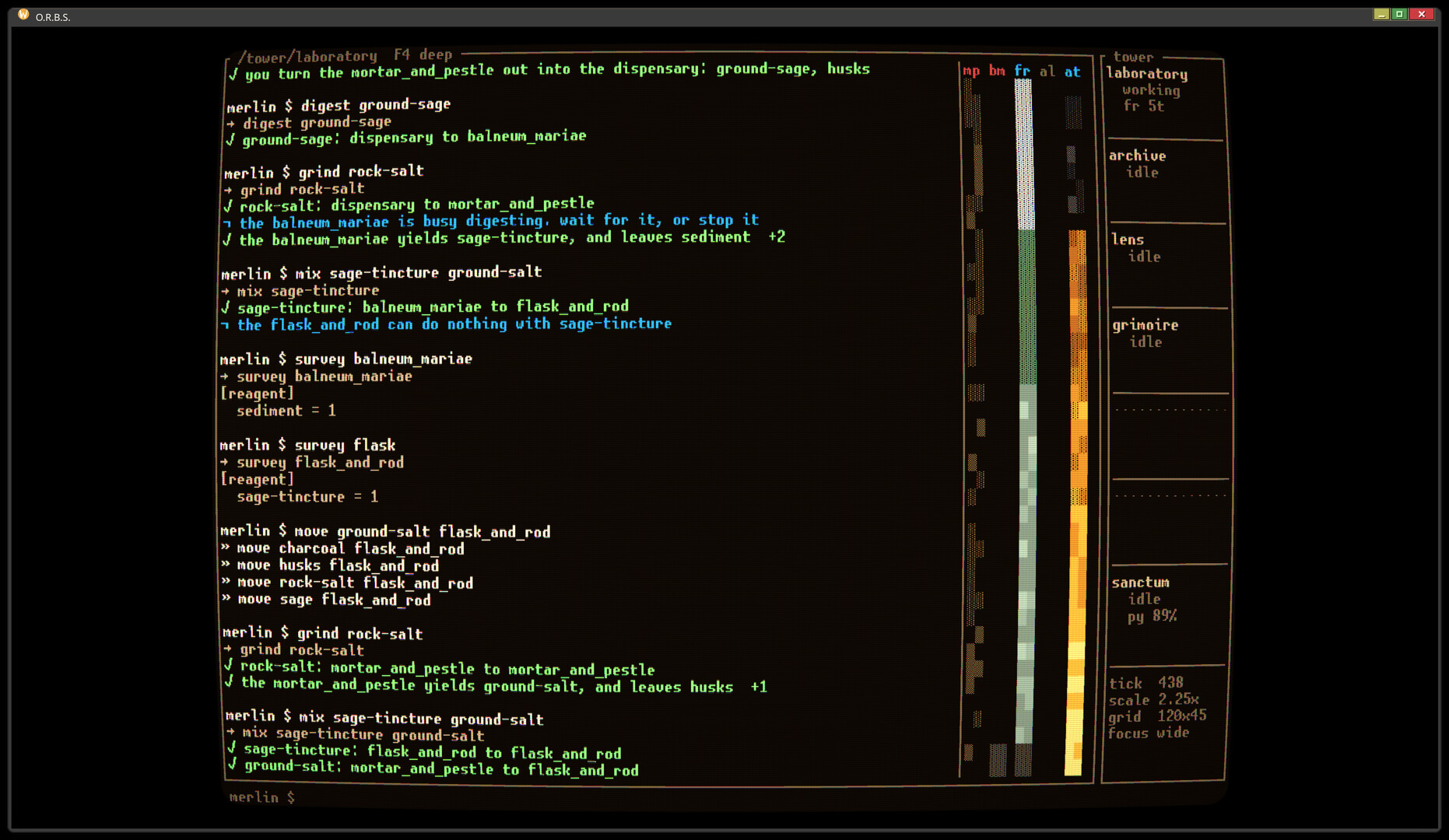
O.R.B.S. — Operational Relic Bewitching System — is a text-only game played entirely through a fantasy command line. There are no sprites, no characters, no illustrations. There is a single curved CRT glowing in the dark, and a prompt waiting for you.
Your Tower Is A File-System
Its rooms are directories and its duties are the things inside them. You walk from the laboratory to the archive by typing "attend archive". You find out what is in front of you by typing "survey". Nothing is hidden behind a menu, because there are no menus.
The orb reads plain English and tells you what it understood. Misspell a word and it will usually find what you meant. Type something ambiguous and it asks rather than guessing.
Learn The Work And Then Give It Away
Every domain in the tower is a real puzzle with its own vocabulary.
The laboratory — brewing. Reagents pass through instruments one stage at a time, each stage feeding the next, and a mortar you forgot to empty will stop the whole chain.
The archive — research. Walk the stacks for fragments and assemble them into scrolls.
The lens — scrying. A rival wizard has sealed your instruments. Break the seals by deduction, and read what spills out of theirs.
The sanctum — defence. Assemble a course of wards to hold your barrier, which decays whether or not you are playing.
More to come...
You can do all of it by hand. Doing it by hand is how you learn it.
Then you write a spell, and never do it again.
Scripting You Spells
A natural(ish) language scripting language is used to scribe your spells. It has variables, loops, conditions, named routines that take arguments, and questions it can ask about the world — "is the mortar idle", "does the cabinet hold four fragments", "which way out of the maze has been walked least." It is a real language, small enough to hold in your head, and it is written in an editor inside the game that explains itself as you type and shows you how the orb will read each line before you run it.
A spell you invoke runs while you watch. A spell you bind keeps running while you are three rooms away doing something else.
Then Something Comes For The Automation
A siege is not a fight. It is an intelligent enemy attacking the machine you built — poisoning the logs your scripts read, renaming a reagent so a spell that named it silently stops working, tampering with the state your conditions test against.
Your instruments are still there. Your spells are still running. Something in the chain is lying to you, and the only way through is to work out which part — using the same diagnostic commands you have been using all along, under time pressure, while the tower keeps ticking.
Made For Reading
Nothing in this game flashes. Not the boot sequence, not an alert, not anything. That is a decision, not an omission.
No mechanic requires fast typing. The world advances once per second and your commands queue to the next tick. Where a task would otherwise reward speed, the answer is to automate it — which is the whole game.
No meaning is carried by colour alone. Every colour is duplicated by a glyph or a word, so the game reads correctly in greyscale.
The CRT is fully optional. One key turns the curve, the glow and the scanlines off. Another cycles the phosphor scheme.
One key reads the whole screen as sentences instead of as a grid — the foundation for screen-reader support.
Under It
Written in Rust. Fully deterministic: the same seed and the same commands produce the same tower every time, which is what makes a saved game a replay rather than a snapshot. Your save is human-readable text you can open in an editor. Single-player, no networking of any kind, no telemetry, no account. Please support the open source community. This game would not be possible without the incredible time commitment of the maintainers of Rust, Bevy and the open game art community.
The orb warms to your touch.
スクリーンショット
ATTENTION
注目度メトリクス
プレイヤー推移
データ蓄積中 24時間平均選択した期間に観測データはありません。
Steamフォロワー推移
2件以上で集計 直近7日選択した期間に観測データはありません。
プレイヤー数とフォロワー数は意味と単位が異なるため、 別々の時系列として表示しています。補間した値は使用していません。
発売前注目度の基礎指標 発売前タイトルのため、Steamフォロワー数と7日増加を中心に注目度を観測します。
| 指標 | 現在値 | 観測状況 |
|---|---|---|
| 現在プレイヤー数 | 未集計 | 最終観測:未集計 |
| 24時間ピーク | データ蓄積中 | 未集計・直近7日 0件 |
| Steamフォロワー数 | 1人 | 最終観測:2026年9月8日 21:20(27日経過) |
| 7日フォロワー増加 | 2件以上で集計 | 履歴あり・更新待ち・直近7日 0件 |
PlayMEXが保存した観測値です。取得時刻と観測数を あわせて確認できます。
ジャンル・機能
機能カテゴリ
#category_contrast_controls#category_playable_at_your_own_paceSteamクラウドSteam実績いつでもセーブ可能カスタム音量調整キーボードのみのオプションテキストサイズの調整ファミリーシェアリング時間制限付き入力なしでプレイ可能色のオプション
ゲームライフログ
所有ゲームとして同期されると、 このゲームの記録を残せます。