


GAME DETAIL
Par Under Review
種別:ゲーム
発売日:近日登場
日本語対応
価格未定
What’s left of golf when you take away the swing? Every decision. In the 1930s, as numbered irons arrive, you test new courses on paper, with a deck of clubs and a pair of dice standing in for the golfer. Read the odds, plan for the miss. A turn-based roguelike where the rules come from golf itself.
このゲームについて
Steamの詳しい説明を読む
EVERY DECISION, NONE OF THE SWING
Before a golf course is built, it is drawn, and before anyone plays it, somebody has to check that the drawing plays the way it reads. That somebody is you, and you do it at a desk.
It is a busy desk. In the 1920s courses go up by the hundred every year, a new profession lays them out, and it has a new idea: a good hole should offer a choice, a safe way round and a bold way over, with the hazard placed where the tempting line runs. That is why the period is called the golden age of golf course architecture. Even par is decided on paper, from a table of yardages, before anyone has played the hole.
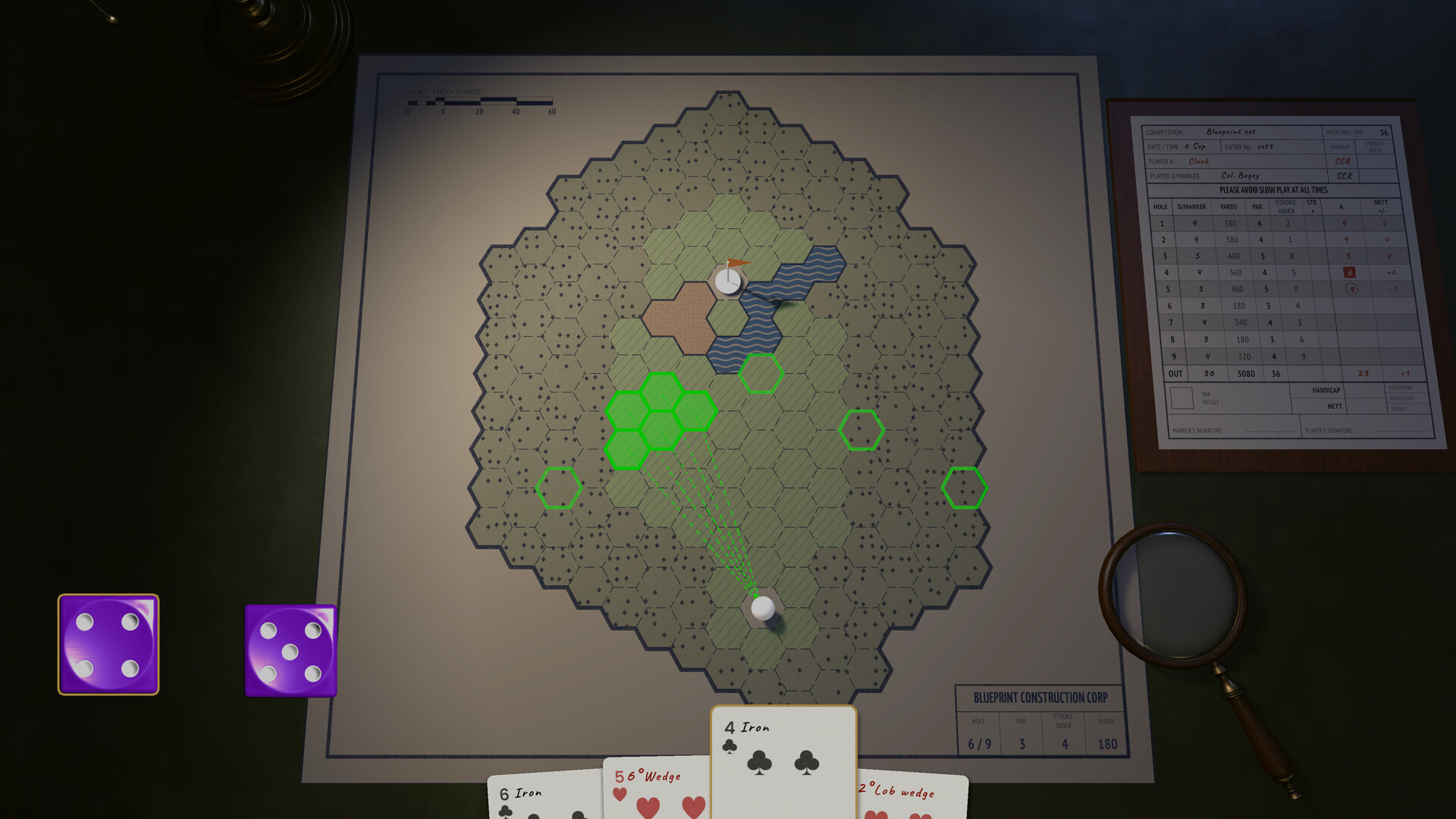
A pair of dice stands in for the golfer. A deck of clubs stands in for the bag. You play each hole through on the blueprint, mark the strokes in pencil, and sign off on the sheet: par holds, or it doesn't. There is no swing meter, no timing, no test of reflexes. The decision is yours.
HOW A STROKE WORKS
To the golfer, a shot is technique. To the person who builds the course, a golfer is a set of odds: how often a shot of this length lands where it was aimed, how often it drifts, how often it comes up short. Even the best players miss, and the chance is never zero. That is what the dice model. Roll two, keep one, and the number you keep is how far a clean shot goes today. You know it before you choose, so the choice is the golf: play the number full, chip it short, swing for more, or pitch it over the trees, each a different bet on where the miss can land. The blueprint shows every place the ball can end up, and how likely each one is, before you commit.
The ground matters the way it does on a course. From the rough the big swings get wilder. Sand steals distance. Trees block your line. Water punishes optimism. Knowing where you can afford to miss is the oldest craft in golf. Here it is the whole game: the lines you learn to choose at this desk are the lines good golfers choose on the course.
A DECK OF CLUBS
It is the 1930s, and the bag is out of control. Steel shafts have just been made legal, matched sets are possible at last, and irons come out of the factory with numbers instead of names. Every season brings a new idea, and one rulebook or the other keeps striking them out: a wedge with a concave face that scoops the ball out of sand, a putter shafted through the middle of its head. The players answer by carrying more, twenty and thirty clubs to a caddie, and the fourteen-club rule is on its way. Before the modern bag settles into its shape, the family tree of golf clubs is wide: legends, dead ends, and the overpowered branches the rules cut off.
That tree is your bag. Each club is a card that tells you what a club tells a golfer: how far it goes, which shots it can play, where it can play from. With a limited bag, some rolls will find no good club to spend them on, so the draft is a question of coverage: answer every distance and every lie, or bet on a specialist that turns a dreadful lie into an opportunity and leaves a gap somewhere else. Workshops send prototypes for testing, and a club can be reworked the way a club-maker would: bend a wedge's loft a few degrees and it becomes the next club up; teach a long iron to drive like a wood, as long as the dice give it a clean strike. The same hole becomes a different puzzle with a different bag.
Nothing in the bag is magic. Every club does what a club of its kind does, and its limits are golf's limits, scaled to a sheet of paper. Golf wrote them first.
A NIGHT JOB
The work gets done after hours. A lamp on the blueprint, rain on the window, the radio turned low, the city outside getting on with its evening. The dice go in the ashtray. The odds are read through a magnifying glass. The strokes are marked in pencil and counted on the desk calendar, and the round ends the way every round in golf ends, with two signatures on the scorecard: yours and your marker's. Nothing here is on a clock. Take the shot when you are ready.
CAMPAIGN, DAILY ROUNDS, RUNS
The campaign is 27 holes in three nines, drawn the way the classics of the golden age were drawn, with the bureau's own inspector in the marker's column so you know what each course expected of you. Your first day at the office teaches the method.
The daily round is nine holes everyone plays on the same day: the same course, the same dice, the same weather. A leaderboard keeps the score, and a friend who has already played it can be your marker for the day. The difference is in the decisions.
A run starts with a phone call: the association is thinking of capping the bag, and someone has to find out what a limited set of clubs can do. Draft yours, take it through hole after hole, and keep pace with par to keep going. Prototypes arrive by parcel along the way, and the draft is work, not shopping: no coins, no shop.
No spells, no monsters, no loot. A course on paper, a pair of dice, a bag you chose yourself, a lamp, and a par that holds or doesn't. The only magic is golf.
スクリーンショット
ATTENTION
注目度メトリクス
プレイヤー推移
データ蓄積中 24時間平均選択した期間に観測データはありません。
Steamフォロワー推移
2件以上で集計 直近7日選択した期間に観測データはありません。
プレイヤー数とフォロワー数は意味と単位が異なるため、 別々の時系列として表示しています。補間した値は使用していません。
発売前注目度の基礎指標 発売前タイトルのため、Steamフォロワー数と7日増加を中心に注目度を観測します。
| 指標 | 現在値 | 観測状況 |
|---|---|---|
| 現在プレイヤー数 | 未集計 | 最終観測:未集計 |
| 24時間ピーク | データ蓄積中 | 未集計・直近7日 0件 |
| Steamフォロワー数 | 3人 | 最終観測:2026年9月15日 03:21(9日経過) |
| 7日フォロワー増加 | 2件以上で集計 | 履歴あり・更新待ち・直近7日 0件 |
PlayMEXが保存した観測値です。取得時刻と観測数を あわせて確認できます。
ジャンル・機能
機能カテゴリ
#category_playable_at_your_own_paceDualSenseコントローラーサポートカスタム音量調整カメラの快適性シングルプレイヤーファミリーシェアリングフルコントローラサポートマウスのみのオプション時間制限付き入力なしでプレイ可能色のオプション
注目ポイント
更新あり 直近14日以内にSteamストア更新
ゲームライフログ
所有ゲームとして同期されると、 このゲームの記録を残せます。