

GAME DETAIL
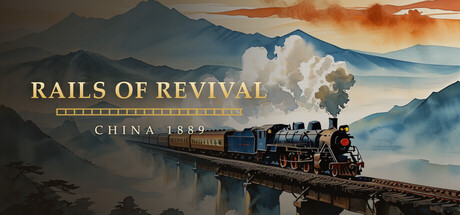
Rails of Revival: China 1889
種別:ゲーム
発売日:近日登場
日本語対応未確認
価格未定
China, 1889–1937. Lay track tile by tile to link mines, mills, ports and cities, and run a supply-and-demand map that breathes. Found your own industries, borrow wisely, ride out wars and revolutions — a railway tycoon where a route is a capacity, not a train to babysit.
このゲームについて
Steamの詳しい説明を読む
Lay the rails. Feed the cities. Carry a nation through its hardest half-century.
It is 1889, and the Peking–Hankow line is still a proposal on paper. You have some capital, a map, and forty-eight years. Link the mines, mills, ports and cities — when freight moves, money moves; when money moves, cities grow.What you will do
Track laid tile by tile
Eight-way track on a grid map. Rivers need bridges, mountains need grades, and every tile has a price. Where the line runs is a bargain between you and the terrain.
A map that breathes
Every city and mine keeps its own stock and price. Deliver freight and the price there falls; cut the supply and it climbs. Twenty-four goods, from coal and salt to silk and machine parts. Capacity is profit.
From ore to locomotives
Coal and iron feed the steelworks; steel feeds the rail mill and the locomotive works. Cotton becomes yarn, yarn becomes cloth. Found your own mills and haul your own goods on your own line.
Cities the railway built
Where freight arrives, cities grow. Courtyard houses become lane-house blocks, shopfronts become trading houses, populations double — every skyline on the map is something your railway delivered.
History keeps its timetable
The Sino-Japanese War, the Boxer crisis, the 1911 Revolution, the warlord years. Lines get requisitioned, markets collapse overnight. History arrives on schedule; your network has to take the hit.
Bonds, mortgages and tight money
There is never enough money to build. Issue bonds, mortgage your lines, reinvest — and watch interest rates turn when silver crashes or the banks fail. Borrowing is a skill; paying it back is the business.
Eight generations of engines
From the Dragon replica and the Mogul to the Mikado and early diesels. Pulling power, speed and reliability all trade off — which wagons to couple and what to haul is your call. No signals, no deadlocks: a route is a capacity, not a train to babysit.
Campaign, free play and a map editor
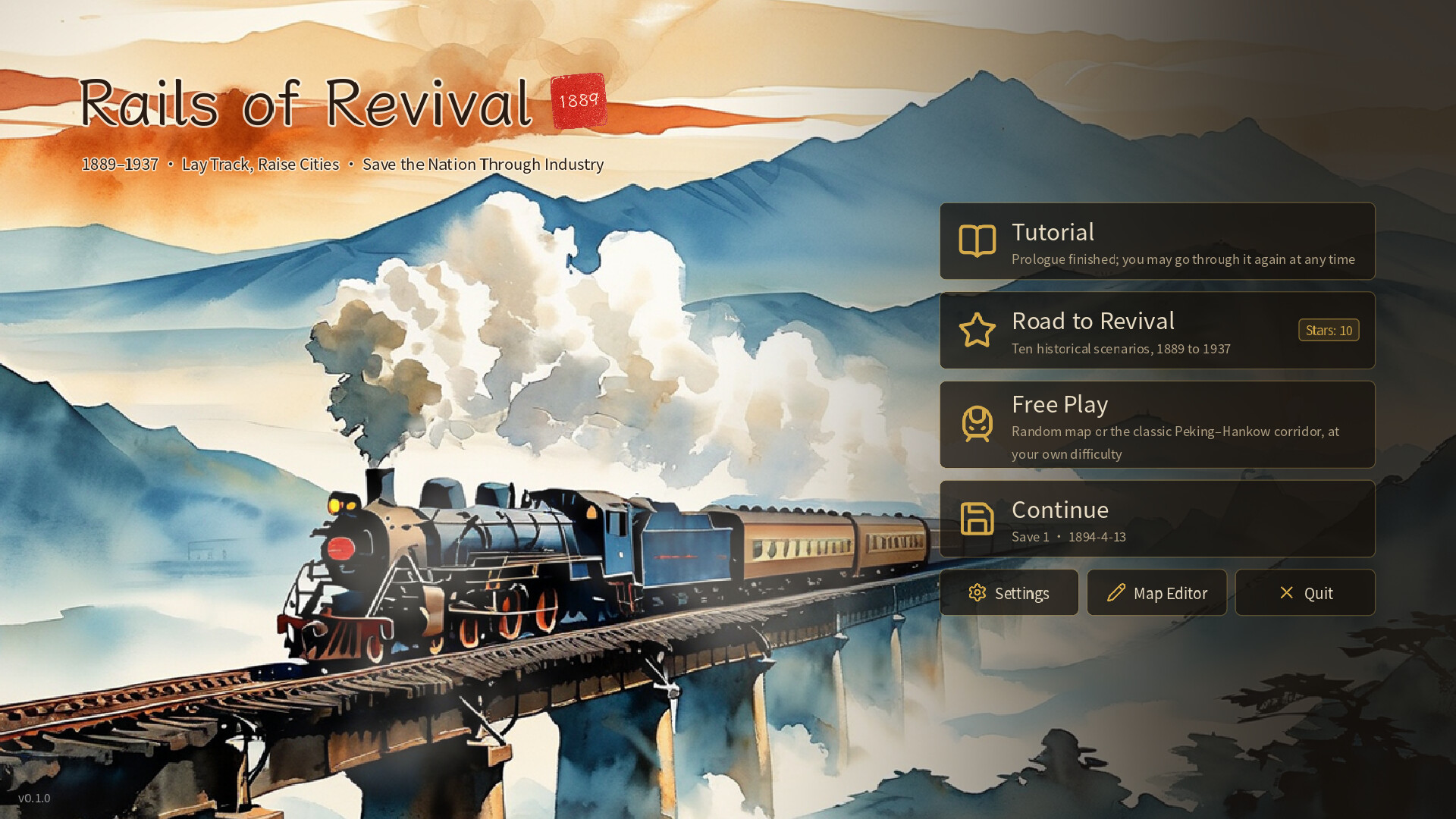
A playable prologue teaches the ropes. Ten campaign levels each pose a management problem with three stars to earn. Free play offers seven map layouts in three sizes — or draw your own country in the map editor. Every random map has a seed code: send it to a friend and they get the very same map.What makes it different
A route is a capacity, not a train — There are no signals to place and no deadlocks to untangle. A route is a path, an engine, a set of wagons and a schedule; its throughput is worked out from those. The trains you see are the picture, not the problem — so a forty-route network late in the game is still a strategy game, not a traffic jam.
A period games rarely visit — China from 1889 to 1937: the late Qing reforms, the scramble for railway concessions, the fall of an empire, the warlord years. The events arrive on their historical dates and land on your network — as requisitions, panics, booms and charters.
Every number explains itself — Open any city, mine or mill and the first line tells you in plain words what is wrong and what to do next — which good is short, where the nearest surplus is, why a factory is idle. Click a figure and you see what feeds it.
Maps you can hand to a friend — Every random map comes with a fifteen-character seed code. Send it over and your friend gets the same mountains, the same rivers and the same coalfields — then compare how each of you built on them.
Who it is for
Players who miss the supply-and-demand maps of Railroad Tycoon and the production chains of The Settlers, and want them without signal micromanagement: here a route is a capacity, not a train to babysit. Also for anyone curious about a period games rarely touch — China between 1889 and 1937, when building a railway meant bargaining with terrain, creditors, warlords and history itself.Languages and features
Interface and all text in English, German, Simplified Chinese and Traditional Chinese. Single-player. No in-game purchases, no ads, no account.
スクリーンショット
ATTENTION
注目度メトリクス
プレイヤー推移
データ蓄積中 24時間平均選択した期間に観測データはありません。
Steamフォロワー推移
2件以上で集計 直近7日選択した期間に観測データはありません。
プレイヤー数とフォロワー数は意味と単位が異なるため、 別々の時系列として表示しています。補間した値は使用していません。
発売前注目度の基礎指標 発売前タイトルのため、Steamフォロワー数と7日増加を中心に注目度を観測します。
| 指標 | 現在値 | 観測状況 |
|---|---|---|
| 現在プレイヤー数 | 未集計 | 最終観測:未集計 |
| 24時間ピーク | データ蓄積中 | 未集計・直近7日 0件 |
| Steamフォロワー数 | 未集計 | 最終観測:未集計 |
| 7日フォロワー増加 | 2件以上で集計 | 未集計・直近7日 0件 |
PlayMEXが保存した観測値です。取得時刻と観測数を あわせて確認できます。
ジャンル・機能
機能カテゴリ
SteamクラウドSteamランキングSteamワークショップSteam実績データファミリーシェアリング
注目ポイント
更新あり 直近14日以内にSteamストア更新
ゲームライフログ
所有ゲームとして同期されると、 このゲームの記録を残せます。