

GAME DETAIL
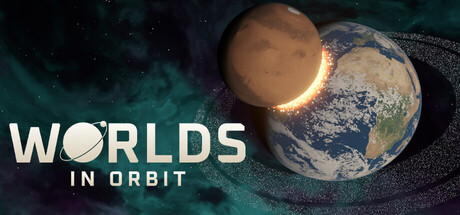
Worlds in Orbit
種別:ゲーム
発売日:近日登場
日本語対応
価格未定
Collide planets and disrupt solar systems in a space simulator built on Newtonian N-body gravity. Create your own worlds, change their mass, rotation, and atmospheres, and watch oceans freeze or evaporate as temperatures change.
このゲームについて
Steamの詳しい説明を読む
Worlds in Orbit is a space simulator where you collide planets, build solar systems, and create your own worlds. Stars, planets, and moons interact through Newtonian N-body gravity, so changing one body can reshape the orbits around it. Change a world’s mass, rotation, atmosphere, or temperature and watch how it responds.
Make your own worlds
Create temperate, arid, frozen, volcanic, cratered, or alien worlds. Start with a procedurally generated world or a bare sphere. Shape mountains, plateaus, canyons, rifts, volcanoes, craters, lake basins, and seabeds.
Forests, grasslands, deserts, wetlands, tundra, and ice give each world its own character. Terrain and surface cover have separate layers, with undo and redo for revising individual regions.
Adjust ocean levels, clouds, and atmosphere, along with your planet’s mass, size, tilt, and rotation.
Gas and ice giants have their own editor for cloud bands, colors, and storms.
The worlds you create respond to gravity, heating, cooling, and collisions. Save them to your object library and reuse them in other simulations.
Build your own solar system
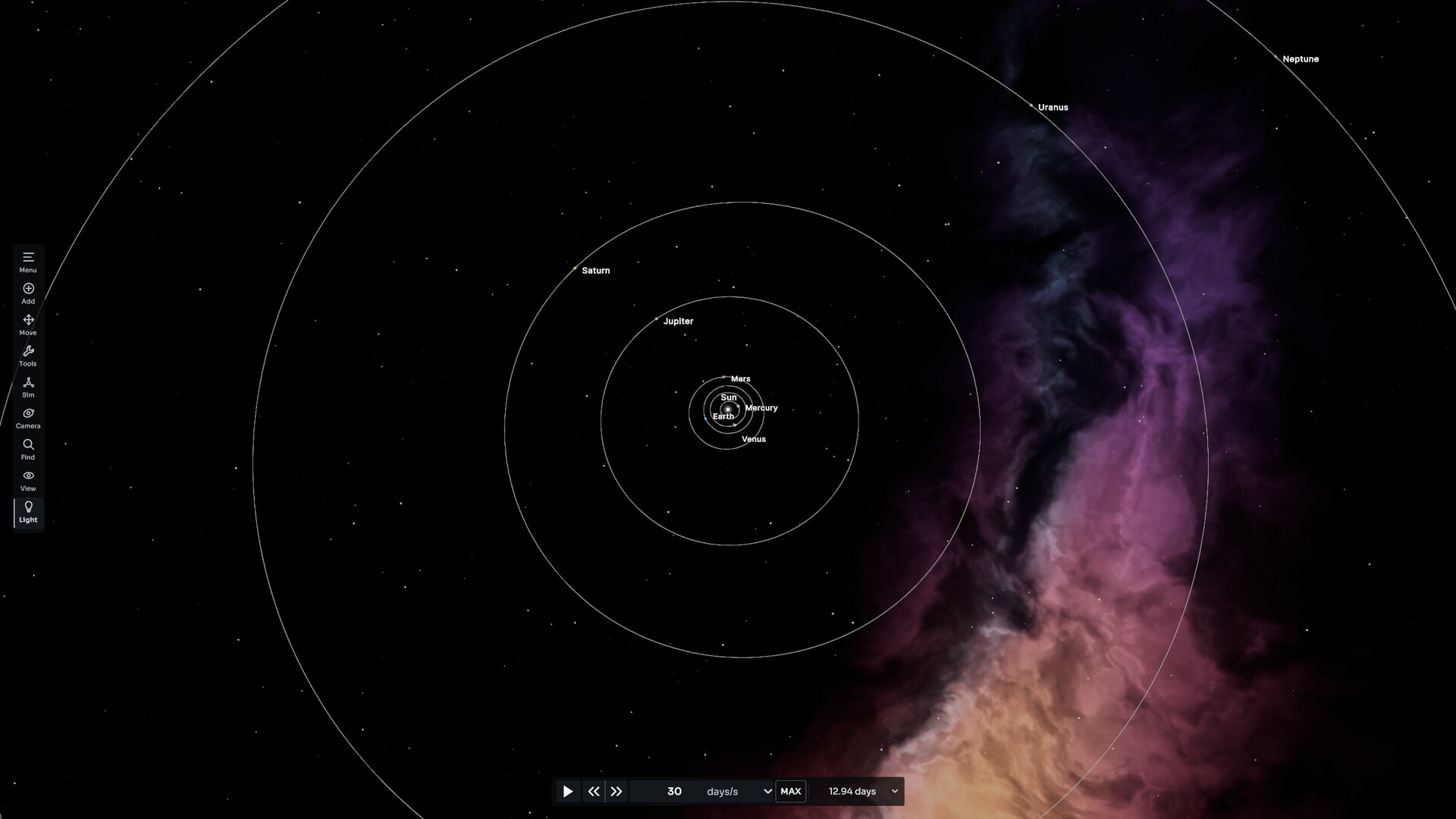
Build solar systems from catalog objects and worlds you’ve made, with moons orbiting planets and planets orbiting stars. Each body pulls on the others through Newtonian gravity. Changes to mass, speed, or direction can reshape nearby orbits, lead to captures, or send worlds toward a collision.
Surround planets with rings of ice and rock. Stars have adjustable temperatures, brightness, mass, and size. Black holes can have gas discs that respond to close encounters.
The simulation can be paused, slowed down, or sped up.
A changing climate
A planet’s temperature changes as it receives energy from its star and loses heat to space. Its orbit and atmosphere affect that balance. Surface temperature can also be adjusted directly.
Oceans can freeze, ice can melt, and water can evaporate as conditions change. Atmospheric pressure and gas composition influence these processes. Snow, sea ice, and cloud cover respond too, while vegetation changes color as the world warms or cools.
Water, gases, rock, and metal can be added or removed. Icy and rocky impacts can also deliver new material, changing a planet’s composition.
A habitable zone guide marks where liquid water may be possible, depending on the planet’s atmosphere and surface conditions.
Worlds under stress
Tidal forces during a close encounter can stretch a moon and tear material away, sending fragments onto new paths.
Planetary collisions heat surfaces and throw material into space. The bodies’ sizes, impact speed, and angle affect the outcome. Merging stars can leave a surviving star surrounded by expanding gas.
Rotation also changes a world’s shape. Faster spin can flatten its poles, widen its equator, and shift shorelines as the ocean surface adjusts.
From orbit to the surface
Explore rocky worlds from orbit down to ground level. Descend to mountain slopes, follow coastlines, and see the terrain up close.
Save your simulations and custom worlds to revisit a favorite system, continue an experiment, or compare different versions of it.
スクリーンショット
ATTENTION
注目度メトリクス
プレイヤー推移
データ蓄積中 24時間平均選択した期間に観測データはありません。
Steamフォロワー推移
2件以上で集計 直近7日選択した期間に観測データはありません。
プレイヤー数とフォロワー数は意味と単位が異なるため、 別々の時系列として表示しています。補間した値は使用していません。
発売前注目度の基礎指標 発売前タイトルのため、Steamフォロワー数と7日増加を中心に注目度を観測します。
| 指標 | 現在値 | 観測状況 |
|---|---|---|
| 現在プレイヤー数 | 未集計 | 最終観測:未集計 |
| 24時間ピーク | データ蓄積中 | 未集計・直近7日 0件 |
| Steamフォロワー数 | 未集計 | 最終観測:未集計 |
| 7日フォロワー増加 | 2件以上で集計 | 未集計・直近7日 0件 |
PlayMEXが保存した観測値です。取得時刻と観測数を あわせて確認できます。
ジャンル・機能
機能カテゴリ
#category_contrast_controls#category_playable_at_your_own_paceカメラの快適性テキストサイズの調整ファミリーシェアリング時間制限付き入力なしでプレイ可能
注目ポイント
更新あり 直近14日以内にSteamストア更新
ゲームライフログ
所有ゲームとして同期されると、 このゲームの記録を残せます。